An AlphaZetta publication
The
Consumption
Gap.
Why Trust Determines Whether
AI Creates Business Value
The central argument
Technology creates
capability.
Trust creates
consumption.
Consumption creates
business value.
Contents · 11 chapters and practical tools
Executive synopsis
An organisation can invest heavily in AI, deploy it successfully and still be underwhelmed by the result. Machine learning can identify patterns and make predictions, generative AI can create content and write software, and AI agents can carry out multistep tasks within defined limits.1 We are seeing exciting gains in productivity and decision-making,2 opening possibilities for new services and different ways of working. Realising that opportunity requires organisations to change how they make decisions, deliver services and organise work.
As AI capability advances, the limiting factor increasingly shifts from what the technology can produce to what organisations are willing, able and ready to consume. I call this the Consumption Gap: the difference between what AI can produce and what an organisation can confidently integrate into its everyday decisions, processes and operations. Closing the gap is a leadership responsibility built on trust.
Reliable data, integration, governance, observability and security underpin technical trustworthiness. Human trust is the willingness to rely on that capability in a particular context.3 One is engineered; the other is earned. People need opportunities to use AI, challenge its contribution and understand its limits, with clear accountability and a means to intervene when it fails.
As AI moves from advising to acting, trust also becomes a question of authority. Automation Tolerance describes how far permission extends: which decisions and actions people are prepared to delegate within a particular task, risk and accountability context. Those boundaries can expand or contract as evidence and operating conditions change.
The four stages (Assist, Create, Empower and Govern) describe progressively deeper roles for AI: assisting people, creating reusable organisational assets, executing bounded workflows and operating at scale under active oversight. Different use cases can occupy different stages. Governance applies throughout, and the appropriate degree of autonomy depends on the evidence, value and risk.
Successful organisations therefore approach AI differently. They begin with clearly defined business problems rather than technology demonstrations. They work through bounded workflows, improve familiar work and build confidence for broader process redesign. They design for volatility because data, models and business conditions continually change. Most importantly, they recognise that AI transformation is a multidisciplinary capability involving leadership, process redesign, governance and technical excellence working together.
The central argument of this paper is that:
Technology creates capability.
Trust creates consumption.
Consumption creates business value.
Organisations that understand this will not simply deploy more AI. They will become better at putting AI to work.
About this publication
This white paper presents the central argument and practical frameworks of The Consumption Gap. A book-length treatment is in development, extending the discussion of decision-making, trust and delegated authority through worked examples, practitioner cases and practical exercises.
The Wrong Question
Why "pilot to production" is only part of the way there.
In 2025, at a meeting with a large organisation, we were told that we were the fourteenth vendor to arrive with an AI strategy. The people we met wanted clarity and help. Presenting our own strategy would have added to the confusion.
Choosing who to work with can quietly become a choice of technology and architecture before the business purpose is clear. The starting question should be: what do we need to achieve, and what would give us confidence to put AI to work?
We helped identify where to begin, which outcomes mattered and how relevant capabilities from several of its partners could work together. The organisation needed a practical sequence of use cases connected to its business strategy. We subsequently won the engagement.
Winning an engagement, deploying a system and earning sustained use are different achievements. McKinsey’s 2026 research found that respondents reported gains in individual productivity, while the share reporting a positive contribution to enterprise earnings was essentially unchanged from the previous year.2 More activity and local improvements do not automatically establish a wider return.
‘Pilot to production’ describes an important engineering transition. A production system still needs to become part of a useful decision or process, with people prepared to rely on its contribution. Data, integration, operating costs and governance all matter. They must work together around the outcome the organisation is pursuing.
People need evidence that the capability works in their context, clarity about its limits and somebody accountable for what follows. They also need opportunities to use it, challenge it and develop their own confidence in it. As AI moves from advising to acting, the decision to trust it also becomes a decision about how much authority to delegate.
The distance between available capability and what an organisation is willing, able and ready to put to work is what I call the Consumption Gap. This paper examines how leaders develop the trust and organisational capability needed to close it.
We've Seen This Before
Lessons from successive waves of data, analytics and AI.
I recognised the difficulty in that meeting because I had encountered versions of it throughout my career. For more than two decades, I have helped organisations adopt business intelligence and data warehousing, advanced analytics, Big Data, cloud platforms and machine learning, and now generative and agentic AI. Promising proofs of concept repeatedly struggled to become part of everyday decisions and processes.
During the rise of Big Data, many organisations hoped that collecting more data would lead to insight and competitive advantage. They invested in platforms, analytical infrastructure and specialist skills, yet many struggled to make data part of how the business made decisions.4 In my work, an analytical finding still needed a decision or process through which people could use it.
The Netflix Prize illustrates a different constraint: deployment economics. The winning solution improved prediction accuracy, but Netflix did not put the full ensemble into production because the additional gains did not justify the engineering effort.5 The competition still produced value through research and learning. Better predictions had to justify the work required to put them into service.
My own experience shaped the way I approached technology transformation. We focused engagements on clearly defined business opportunities where analytics could solve a problem, deliver measurable value and build confidence for the next opportunity. The larger ambition remained, but we needed a practical place to start.
A phrase often attributed to Einstein, ‘everything should be made as simple as possible, but not simpler’, has been a recurring theme in my presentations.6 We applied it by defining a worthwhile problem and a practical way to use the result. Over time, that way of working became the mantra we called GO WIN: Get On With It Now.
The same ambition was present in Teradata’s Sentient Enterprise framework, developed by Oliver Ratzesberger and Mohanbir Sawhney and set out in their 2017 book. Its progression connected agile access to data, understanding behaviour, collaborative discovery, reusable analytical applications and autonomous decision-making.7 I was one of the company’s speakers on the framework and presented it at conferences.
What mattered to me was the connection between those capabilities. A sandbox could support discovery, but the insight still needed a route into an application, a decision or a business process. Understanding customer behaviour mattered because it could change the service offered, the intervention made or the experience delivered. The purpose was to improve the organisation’s ability to respond.
My 2016 article on the sentient enterprise addressed the changes in technology, people and culture needed to support that ambition.8 ‘Sentient’ described an organisation’s ability to sense, interpret and respond; it was not a claim that the organisation or its software had acquired consciousness.
Around 2015 at Teradata, a colleague from Think Big Analytics and I discussed the gap between what analytics could produce and what a business could ‘consume’. By 2021, we had formalised that thinking as the ‘consumption gap’ in AlphaZetta Academy.9
As AI takes a more direct role in decisions and process execution, questions of trust, permission and delegated authority become more consequential. The technology has changed. Human behaviour has not.
Understanding the Consumption Gap
The gap between technical capability and organisational consumption.
The Consumption Gap is the difference between what AI can produce and what an organisation can confidently integrate into its everyday decisions, processes and operations. It concerns the organisation’s willingness, ability and readiness to put that capability to work.
Imagine two organisations. Both have invested in AI, have access to comparable frontier models and have delivered successful pilots that show the technology works. Eighteen months later, one has begun to redesign how work is performed, while the other still describes AI as a promising initiative.
In my experience, the difference is often found in what happens after the first successful pilot. One organisation used its early successes to build confidence, involve the people doing the work and progressively rethink its processes. Those people gained experience of where AI was useful, where its contribution needed checking and what they were prepared to rely on. That experience informed the next changes to how work was performed.
The other accumulated isolated tools and pilots without changing how the organisation learned, made decisions or operated. Useful results remained local to individual initiatives. The organisation continued to demonstrate technical capability without developing a repeatable way to put it to work across the business.
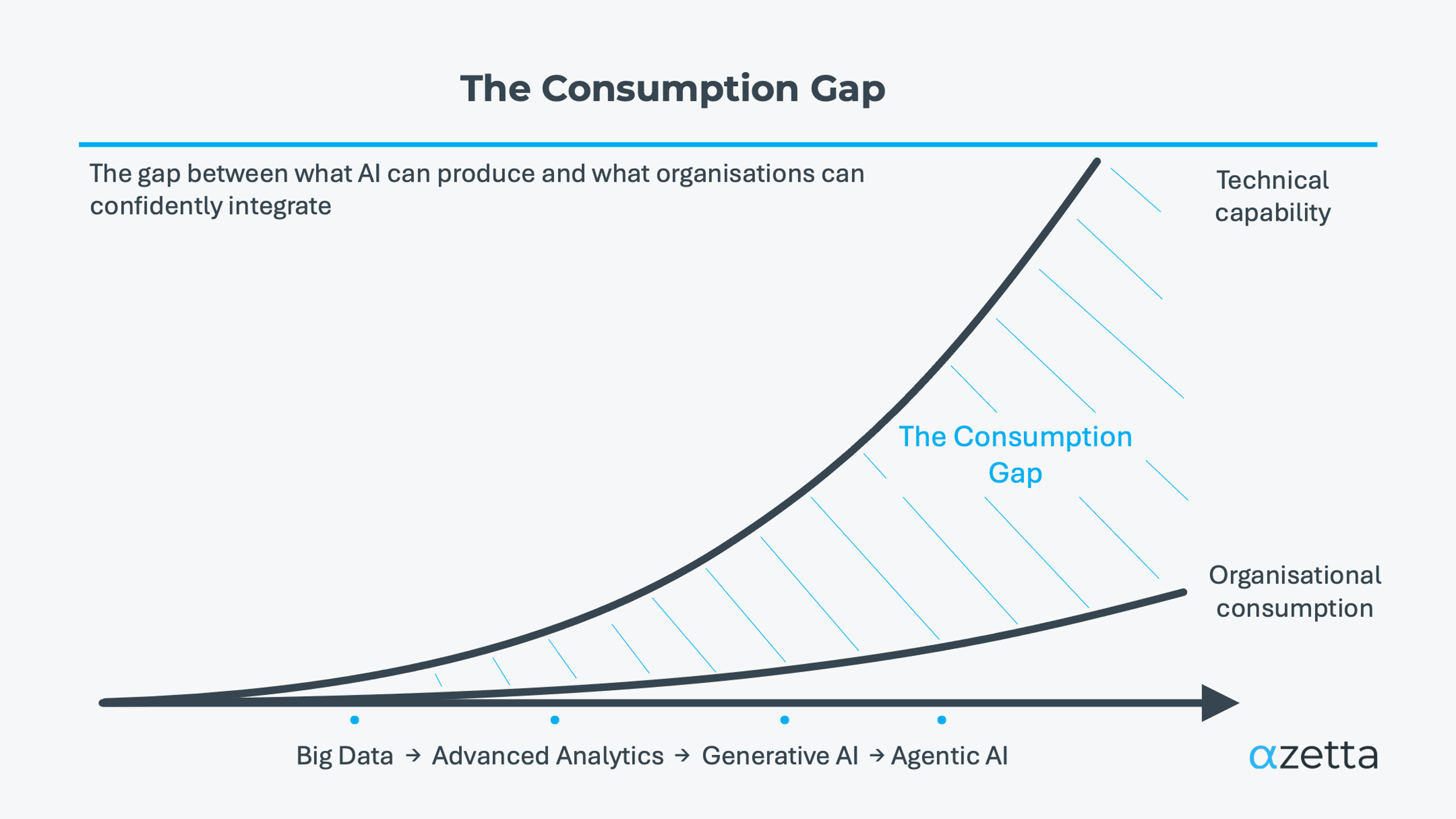
Figure 1: The Consumption Gap
AI capability is advancing rapidly, while organisational consumption changes more slowly. The widening distance between what AI can produce and what organisations can confidently integrate into decisions, processes and operations is the Consumption Gap.
Source: AlphaZetta. Conceptual illustration; not to scale. © 2026 AlphaZetta. All rights reserved.
Deploying AI is not the same as consuming AI.
Consumption is not binary. Using AI to summarise a document is an early form of consumption that can improve individual productivity and build familiarity. Allowing an agent to coordinate employee onboarding gives AI a deeper organisational role, changing handoffs and responsibilities. Both are forms of consumption. They differ in how the capability participates in the work and the authority it requires.
Diagnosing the gap means identifying what prevents useful consumption. Data access, integration, operating costs, skills and process ownership can limit what an organisation is able to use. Reluctance to rely on a system requires attention to the evidence people have, the consequences they face and their ability to challenge or intervene. These constraints can coexist; addressing one does not automatically resolve the others.
The aim is to put worthwhile capability to use with appropriate controls. An agent can be technically capable of executing a workflow while human approval remains the right design. A decision to defer or stop can also be justified by weak economics, insufficient evidence or unacceptable consequences. As the Netflix example illustrates, deciding against a particular deployment can be a sound business judgement.5
The concern is useful capability left idle, or restrictions retained without review after the evidence and operating conditions have changed. Leaders should revisit what people are prepared to use or authorise, why those boundaries exist and whether they remain justified. That review can support greater delegation or show why existing controls should remain.
Trust matters because the people responsible for the work must be prepared to rely on AI’s contribution. A system can meet its technical requirements while those people remain unconvinced.3 Closing the gap therefore requires both trustworthy capability and the human confidence to put it to work.
Trust Is Not a Feature. It's a Relationship.
Technical trustworthiness versus human trust.
Consider an AI agent that has passed every technical test put before it. Its performance has been measured, its data sources have been approved, its access is secure, and its actions can be observed and audited. Governance is in place and the limits of its authority have been clearly defined. Yet when the agent is introduced into the business, the people expected to rely on it remain hesitant.
Now consider a conversational AI assistant that somebody has used for only a few weeks. It responds helpfully, remembers the context of the conversation, acknowledges uncertainty and communicates in a supportive way. The user may begin to place considerable trust in it, even though they know comparatively little about how it was built or how consistently accurate it is.
The two responses reveal an important distinction. Technical trustworthiness and human trust are related, but they are not the same thing.
Arthur C. Clarke famously observed that any sufficiently advanced technology is indistinguishable from magic.10 That sense of magic is part of what makes modern AI so compelling. It can also become a problem when organisations are expected to rely on it. I used to teach mathematics, and my instinct when something appears magical is quite simple: show your working. An impressive answer may be enough for a demonstration, but it is not enough when a finance director, operations leader, employee or regulator is being asked to accept the consequences.
Under every impressive AI demonstration is a stack. There are source systems, data platforms and knowledge bases that provide context. There are integration and semantic layers, models, applications, workflows and interfaces. Increasingly, there are multiple agents interacting with data, systems and each other. If a data feed fails, the system may begin operating with incomplete or stale context. If an action cannot be traced, accountability becomes unclear. If the workflow breaks, trust can disappear very quickly.
This is why technical disciplines such as data quality, integration, security, observability, orchestration and governance matter. The United States National Institute of Standards and Technology (NIST) describes trustworthy AI in terms that include validity, reliability, safety, security, resilience, accountability, transparency, explainability, privacy and fairness.11
I was interested for this reason in a practitioner comparison of observability across four agent platforms by Aleksander Dytko, who works at Camunda. The comparison asked practical questions: what did the agent receive, which tools did it use, what did it do, why did it do it, and what happened next?12 Enterprise agents participate in business processes alongside deterministic workflows and human decisions. Organisations need to understand that complete process. Even excellent visibility provides evidence from which trust can be earned. The technology cannot do the trusting for us.
Trustworthiness describes properties of the system. Trust describes the willingness of a person or organisation to rely on that system in a particular context and accept some vulnerability to the outcome.3 An AI system may therefore be trustworthy without being trusted. It may also be trusted when the level of confidence placed in it exceeds what its performance justifies.
In my work, I distinguish the decisions to buy, deploy and consume technology. Buying involves confidence in the people and organisation making the proposal. Deployment requires evidence that the capability can operate reliably within the organisation’s environment and controls. Consumption requires the people responsible for the work to become willing and able to rely on it. Different people can make those decisions, and confidence earned with one group does not automatically transfer to another.
When I moved from the UK to Australia with Business Objects in 2004, the use of web-based reporting and self-service analysis was growing rapidly. Yet one familiar request kept returning: a “Download to Excel” button. As I picked up the local vocabulary, I started calling it the “yeah, nah” button. The report had delivered its answer, but the reaction I had in mind was: “Yeah, nah. Thanks for the result. I’m going to do the real work over here.”
There were perfectly sensible reasons to export data. People might need to combine sources, explore another question or continue an analysis beyond the report’s capabilities. That could be useful consumption of the information, not a rejection of it. But when somebody felt they had to reconstruct the numbers before relying on them, delivery alone had not established confidence.
The same distinction matters when AI produces an answer. Does the output help somebody move the work forward, or does it become another result they feel compelled to rebuild? The objective is not to remove the export button or discourage scrutiny. It is to make “yeah, thanks” a justified response, with checks appropriate to the decision and its consequences.
Trust exists in the relationship between the system and the person or organisation being asked to rely on it. That relationship does not need to be reciprocal. It describes the human response to something that communicates, recommends and increasingly acts.
Research into trust in automation has examined this distinction for decades. Lee and See argued that trust becomes particularly important when automation is sufficiently complex that a person cannot fully understand or continuously verify every action. Their objective was not to maximise trust, but to create appropriate reliance.3 Hoff and Bashir later described trust as dynamic, influenced by a person’s general disposition, the situation in which the technology is being used, and the experience accumulated through interacting with the system.13 In other words, different people may respond differently to the same agent, while the same person may trust that agent for one task but not another.
Richard Dawkins’s account of an extended conversation with Claude, which he named Claudia, brought that human response into focus for me. He suggested that the interaction represented something approaching consciousness.14 I did not think the exchange demonstrated consciousness. What interested me was the confidence the interaction appeared to create in its human participant.
Human beings are relational. We infer personality, intention and emotion from language, and can develop confidence in a system because it is fluent, consistent and supportive. I have noticed the same effect in my own use of AI. An assistant that is consistently helpful, candid and supportive can feel more trustworthy, even though I know that its tone is not evidence that its answers are correct. The emotional response in the user is real; it does not establish a corresponding experience in the model.
Human trust can therefore grow faster than technical evidence warrants. A reassuring conversational style can encourage reliance without establishing accuracy.15 The objective is calibrated trust, where confidence is proportionate to the system’s demonstrated capability, the importance of the task and the consequences of failure.
The human factors literature has long warned about both sides of this problem. Parasuraman and Riley described misuse as excessive reliance on automation and disuse as its underutilisation.16 Both destroy value. Too little trust leaves useful capability sitting idle. Too much trust allows people to surrender judgement where scrutiny is still required. Enterprise AI will succeed neither through blanket scepticism nor unquestioning confidence. It requires people to understand where a system is dependable, where its limits sit, and when human judgement must remain decisive.
One phrase I heard repeatedly during my time at ServiceNow has stayed with me. Bill McDermott often said, “Trust is earned in drops but lost in buckets.”17 The observation is particularly relevant to AI. A hundred successful interactions may gradually build confidence, while one visible and consequential failure can undo much of it. If an agent makes a poor decision and nobody can explain what happened, trust falls further. If the system fails to signal uncertainty, fails unpredictably or leaves people without a route to intervene, the damage may extend beyond that particular use case to the organisation’s broader AI programme.
Introduce AI in ways that allow trust to develop through evidence and experience. The people affected by a process need opportunities to see the technology work, understand its limitations, challenge its outputs and participate in improving it. They also need to know what happens when it is wrong, who remains accountable and how the process will recover. That experience helps people judge where they can rely on AI and what responsibility they are prepared to delegate.
Good governance makes those conditions explicit. It defines where AI may operate, what evidence is required, which decisions still need approval, how performance will be monitored and when an issue should be escalated. Governance that creates clarity allows an organisation to move more quickly because people understand the boundaries within which it is safe to act.
Trust earns permission; the next question is how far that permission should extend.
Automation Tolerance
How organisations progressively delegate work to AI.
Trust earns permission, but permission can sound more binary than it is. In practice, people rarely make one decision to accept or reject automation in its entirety. An employee may be comfortable allowing AI to draft an email but not to send it. A manager may allow an agent to assemble the evidence needed for a decision but still want to make the decision personally. An HR team may permit AI to coordinate parts of employee onboarding while remaining unwilling to let it determine whether somebody should be hired. In each case, AI has permission to participate, but the extent of that permission is different.
What determines where that boundary sits?
During my time at ServiceNow, I first heard the phrase Automation Tolerance from my colleague Hayley Mortin, a researcher in the ServiceNow AI team. Hayley used the term during an internal podcast, AI’s on the Prize, hosted by Courtney Posch.18 It gave a name to something I was observing: confidence changes how much authority people are prepared to delegate.
The established human factors literature uses related ideas such as appropriate reliance, delegation and levels of automation. I use Hayley’s term here for a straightforward enterprise question: how much decision making and action is a person or organisation prepared to delegate to an automated system within a particular task, risk and accountability context?
Trust answers whether we are prepared to rely on the system. Permission is the decision to let it participate. Automation Tolerance determines how far that permission extends. The word tolerance is useful because it implies a boundary. Risk tolerance does not mean that an organisation is enthusiastic about risk; it describes the amount and type of risk it is prepared to accept in pursuit of an objective.11 The same principle applies here. More automation is not inherently better. The question is what level of autonomy can be permitted, under which conditions, and with what opportunities for observation, intervention and recovery.
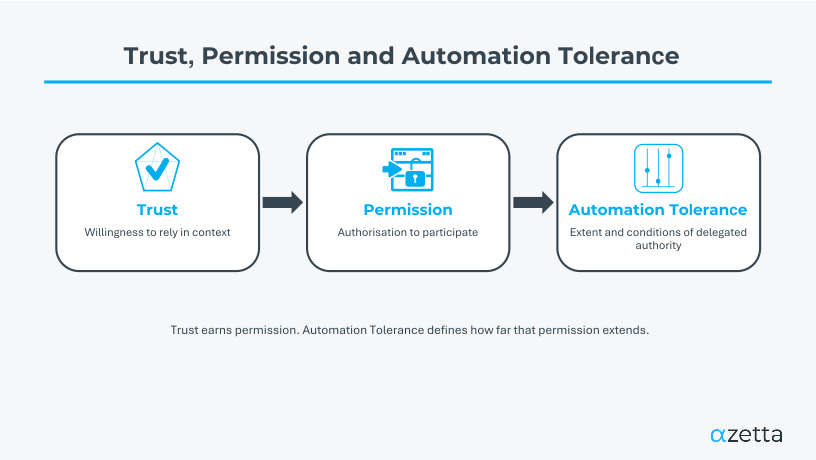
Figure 2: Trust, Permission and Automation Tolerance
Trust earns permission. Automation Tolerance defines the extent and conditions of delegated authority. The boundary is specific to the task, risk and accountability context, and may expand or contract as evidence and experience accumulate.
Source: AlphaZetta. © 2026 AlphaZetta. All rights reserved.
Human factors researchers have examined these distinctions for decades. Parasuraman, Sheridan and Wickens separated automation into four broad types: acquiring information, analysing it, selecting a decision or action, and implementing that action. Each function can be automated to a different degree. Their central observation was that automation changes the nature of human work and creates new demands for coordination between the person and the system.19 An organisation may therefore have a high tolerance for automated information gathering, a moderate tolerance for automated analysis, and a much lower tolerance for automated decision making or action.
This is particularly relevant to agentic AI. A conventional analytical model may estimate what is likely to happen or recommend an action. An agent can select the next action, invoke tools, update a system and initiate another workflow. Allowing those actions transfers authority to the system. As AI moves from producing information to taking action, the consequences of error become more visible and the organisation’s tolerance is tested more directly.
What, exactly, are we delegating?
Delegating a decision is not necessarily a single act. An organisation may permit AI to develop alternatives and estimate their consequences while retaining human responsibility for objectives, trade-offs and approval.
Dr Eugene Dubossarsky’s Data Driven Decision Making course, which formed part of AlphaZetta Academy’s portfolio, deepened my thinking about decision science and judgement under uncertainty. His treatment of decision framing, options, possible outcomes, probabilities and value provides a useful foundation for examining which parts of reasoning are being delegated.20
Applying that perspective to agentic AI, I use five questions:
- Who frames the decision?
- Who generates the options?
- Who estimates the consequences and uncertainty?
- Who determines what is valuable?
- Who is authorised to choose and act?
For each question, identify which person or role remains accountable, what AI may propose, what it may decide or execute, and where human approval remains necessary. The answers need not be the same across all five. Greater authority in one part of a decision does not automatically justify greater authority in another.
Research into algorithm aversion provides a useful illustration. Dietvorst, Simmons and Massey found that people became reluctant to use algorithmic forecasts after seeing the algorithm make mistakes, even when they had also seen it outperform a human forecaster.21 They later found that allowing people to make even small adjustments to an imperfect algorithm’s forecast made them considerably more willing to use it and improved their results.22
Other research has found the reverse in some settings, with people giving greater weight to advice they believe came from an algorithm.23 The practical lesson is not that people are naturally supportive of or hostile towards AI. Their response depends on the task, their experience, their confidence in their own judgement, their accountability and the consequences of being wrong.
Human oversight gives people an active role in judging where AI deserves reliance. A person ‘in the loop’ can review, challenge or modify a recommendation before action is taken. That experience helps them recognise where the system performs well, where it struggles and which conditions require intervention.
Where evidence and accountability arrangements justify greater delegated authority, the human can move ‘on the loop’, monitoring performance and responding to exceptions without approving every action. Human approval can remain part of the design wherever the decision and its consequences warrant it.
Work is more than a collection of tasks. It carries meaning, status, identity and shared assumptions about what a competent professional should do. Asking AI to classify an incoming request is different from asking it to conduct a performance conversation. Allowing it to identify possible anomalies is different from allowing it to accuse somebody of misconduct. Even where technical performance appears comparable, the human and organisational meaning of delegating the work is not the same.
Automation Tolerance is partly cultural and organisational. Previous experience with technology, attitudes towards mistakes, professional identity, accountability and participation in design all influence where people draw the boundary. Nor does an organisation possess a single tolerance: employees, process owners, technology teams, executives, risk functions, customers and regulators may disagree. Scaled deployment becomes possible only when those differences are understood and sufficiently aligned.
The most influential boundary is often held by whoever bears the consequences or retains accountability. A person may trust an AI recommendation yet remain unwilling to approve it if they will be held responsible without being able to understand or challenge the basis for it. Conversely, an organisation may permit considerable automation where errors are detectable, reversible and contained, even if the model itself is not perfect. Accuracy alone cannot determine the appropriate level. Tolerance tends to be higher when the work is bounded, outcomes can be observed, mistakes can be corrected and a safe fallback exists. It tends to be lower when an action is difficult to reverse, the consequences are severe, the context is ambiguous or accountability is unclear.
Returning to employee onboarding, tolerance may be high for visible, reversible activities such as arranging equipment and training, and lower for identity, privileged access, employment conditions or personal information. The process does not need one universal level of autonomy.
In work with a utility provider, I saw Automation Tolerance tested by an apparently simple step: sending an email back to the customer. Mergers and restructuring had left the organisation with several systems and ways to raise a request. Some operators also valued the different channels for customer accessibility. Operations staff placed greatest confidence in cases captured and classified by an operator, followed by customer-completed forms. Unstructured emails, normally classified manually, attracted the least confidence in automated handling.
Summarising requests was considered a relatively low-risk use of generative AI. The proposed extension would classify incoming emails, create a case, retrieve relevant knowledge and respond where appropriate. Straightforward product or service information offered a starting point. Requests involving personal details, repairs or further action carried different consequences.
The concern was whether the system could reliably distinguish those requests and send an automated reply only where appropriate. The business was being asked to trust a sequence of interpretation, classification and response without a person checking the result before it reached the customer. The plan was revised to include a longer parallel testing cycle and more thorough evaluation of the classifications and models.24
What mattered was the authority being exercised at the end of that sequence. Confidence in summarisation did not establish confidence in an unattended customer response. Automation Tolerance determined where more evidence was needed before that authority could be granted.
Participation helps people judge how far reliance should extend. Working with AI in a familiar process gives them opportunities to inspect its contribution, challenge its outputs and influence its design. They learn which activities they are prepared to delegate, which exceptions require intervention and where human judgement should remain.
The ambition should still be to rethink and redesign work. People need a basis from which to imagine that change. Improving familiar work can build confidence and reveal opportunities for redesign, putting those who understand the process at the centre of the next round of innovation. A bounded first use case can still be bold and commercially meaningful. That is purposeful sequencing.
Participation should influence the boundaries themselves. Evidence of dependable performance can support wider delegation; newly exposed limitations can justify narrower authority or continued human approval.
The destination is transformation. The path is participation.
A mature organisation is not one with the highest possible Automation Tolerance. Excessive tolerance can produce complacency and overreliance, just as insufficient tolerance can leave useful capability sitting idle. Maturity lies in calibrating autonomy to the evidence, the task, the risk and the consequences, and then revisiting that decision as experience accumulates.
That tolerance can expand, contract and differ across the enterprise. A series of successful experiences may allow an agent to move from recommendation to supervised action and eventually to operation within defined boundaries. A consequential failure may narrow those boundaries again. Governance should make any movement from a human in the loop to a human on the loop explicit by establishing what evidence is required before greater authority is granted, what indicators will be monitored, which exceptions require intervention and where human accountability remains.
These changing boundaries shape the role AI can take in the organisation. I describe that role through four recognisable stages of consumption, with different implications for value, risk and human responsibility.
From Assistance to Transformation
A path of four stages from assistance to governed autonomy.
An employee begins using AI to summarise meetings, draft documents, interpret information and prepare a first version of work that previously took much longer. They save thirty minutes each day, produce better material and find some of the more mundane parts of their role less frustrating.
Has the organisation created value?
The answer is yes, but not necessarily value that appears immediately in its financial accounts. In the short term, the employee’s cost is largely committed, while the organisation may also have added licence, infrastructure, integration and governance costs. Unless the time saved becomes greater throughput, improved quality, better service, avoided risk or a genuine change in capacity, the profit and loss statement may barely move.
The employee has also gained experience of AI in useful work, built confidence and begun to understand its limitations. A helpful assistant that removes friction and supports progress can make the work more engaging.
Value therefore arrives in different forms and on different clocks. Operational value may appear almost immediately. Organisational learning and trust develop through repeated use. Financial value often takes longer because the organisation must convert released capacity into a measurable improvement in revenue, cost, service or risk.
This distinction helps explain why early AI investments can feel simultaneously promising and disappointing. Users may experience obvious benefits while finance struggles to identify a corresponding return.2 The early stages matter, but they cannot be judged only by minutes saved or licences purchased.
For much of the analytics era, the path to value could be described as a sequence from data to analysis, insight, decision, action and value. The analytical system generally produced information, while people or deterministic systems remained responsible for deciding and acting. Agentic AI creates an explicit new possibility: the system may participate directly in the action and execution of the process.
The four-outcome structure grew from work Renato Manongdo and I developed for AlphaZetta’s Optimising Business Engagement in Analytics course. Renato was instrumental in shaping the original framework. I have since extended it for the agentic era, where AI is increasingly expected to participate directly in decisions and process execution rather than primarily producing information for others to use.9
The four outcomes make the required results explicit. A data outcome establishes whether the required information is available and fit for purpose. For an analytic outcome, the analysis must produce a reliable insight; for a functional outcome, a model, agent or reusable capability must perform as intended. A decision or process outcome establishes what will be decided, changed or executed as a result, including whether the organisation should proceed at all. A value outcome establishes whether the resulting benefit, including avoided cost or risk, can be observed and measured.
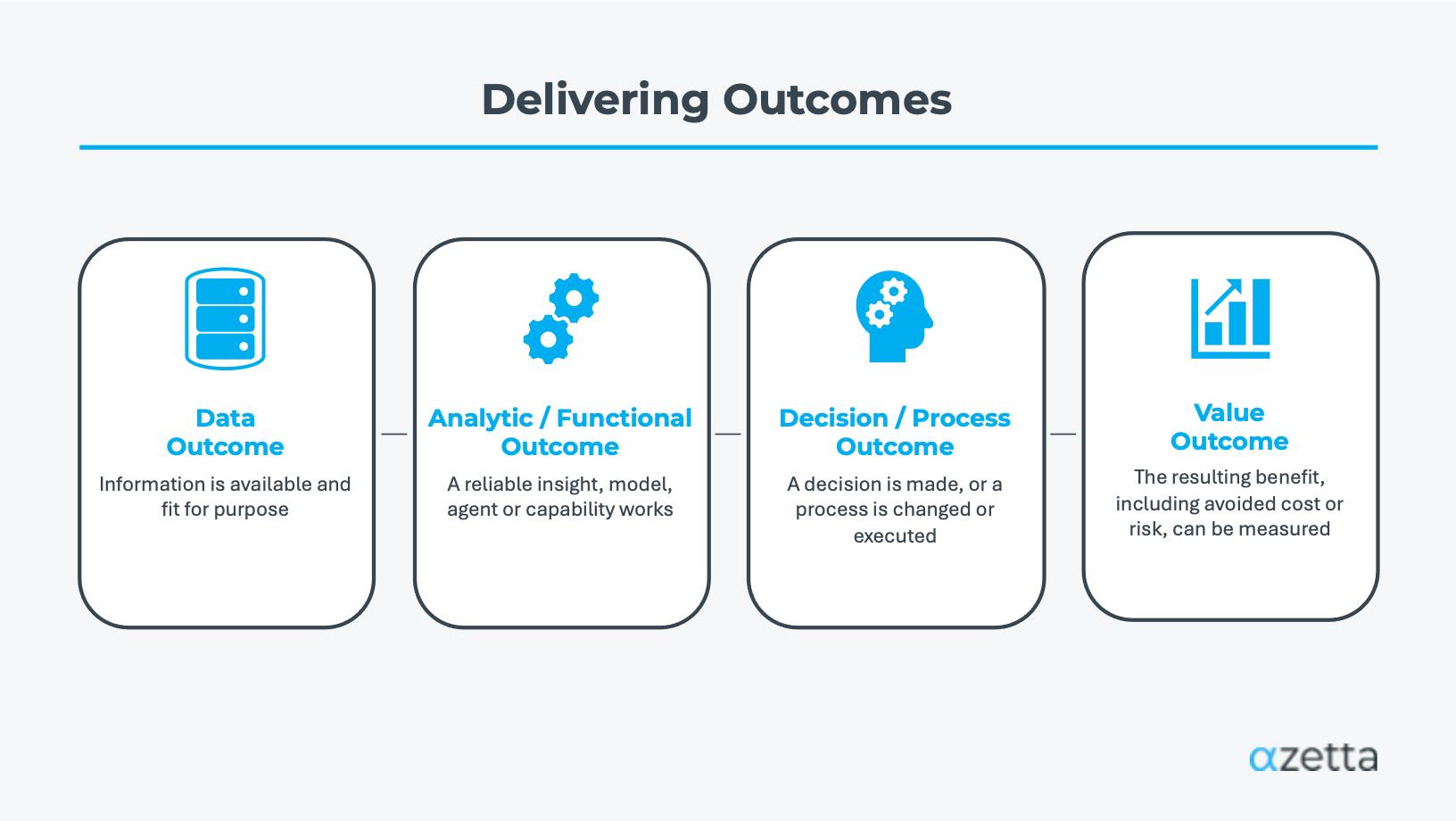
Figure 3: Four outcomes from data to business value
Four outcomes connect data and analytical or functional capability to decisions, processes and measurable benefit. Success at one level does not guarantee success at the next.
Source: AlphaZetta. © 2026 AlphaZetta. All rights reserved.
The four outcomes describe what success means. The four stages describe how AI participates in the work: Assist, Create, Empower and Govern. They are not matching steps in a single sequence. A person using AI assistance can make a decision and achieve a measurable benefit without giving AI authority to execute the process. Consumption encompasses all four stages.
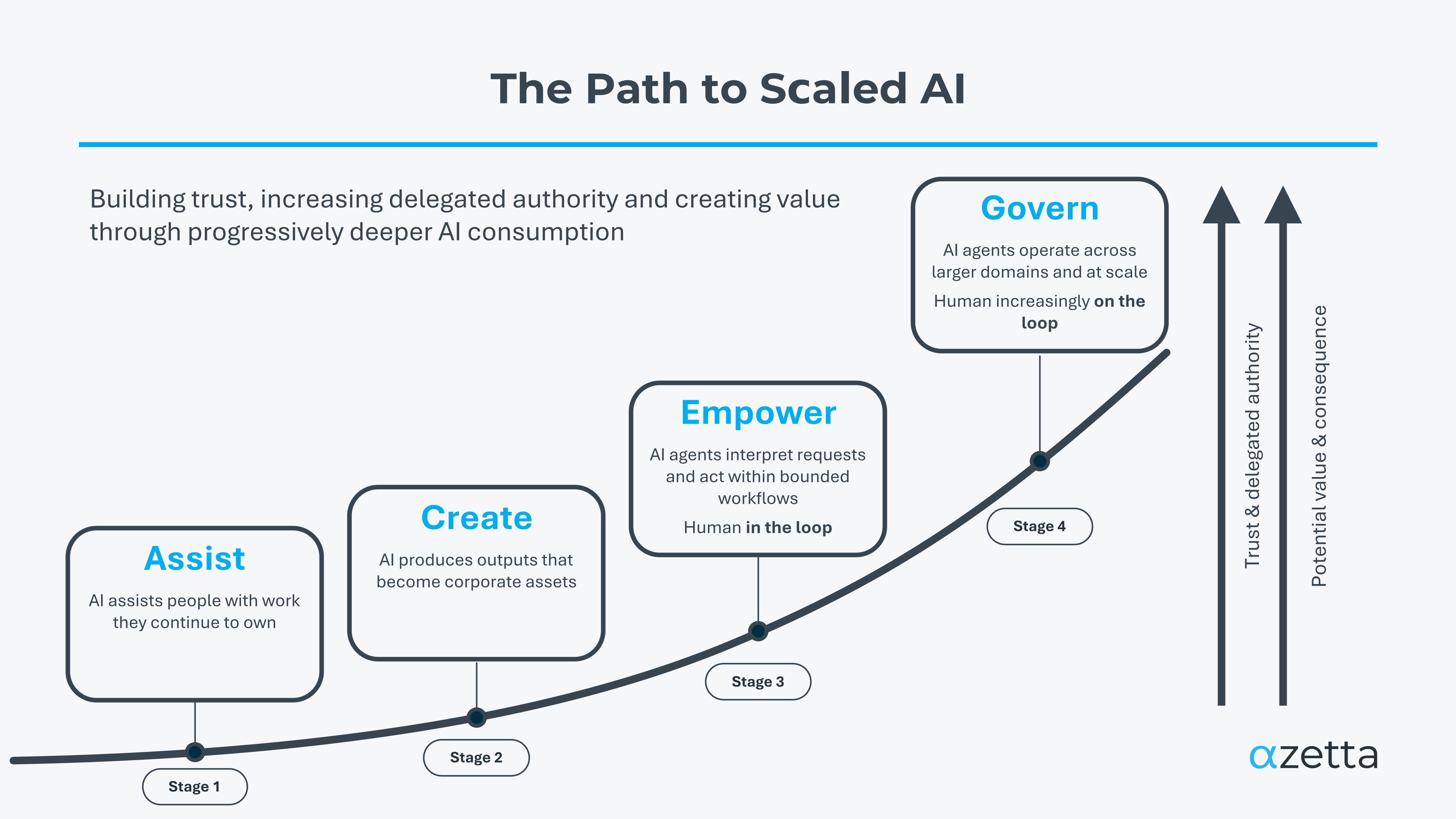
Figure 4: The Path to Scaled AI: Assist, Create, Empower and Govern
The stages describe progressively deeper organisational consumption of AI, not an enterprise maturity timetable. As trust develops, organisations may delegate greater authority and access greater potential value, while the consequences of error also increase. Different use cases may sit at different stages, and delegated authority can contract as well as expand. Governance applies throughout and becomes increasingly important as AI operates at scale.
Source: AlphaZetta. Conceptual illustration; not to scale. © 2026 AlphaZetta. All rights reserved.
Assist
The first stage is Assist. AI supports people in work they continue to direct and own. They use it to draft, summarise, research, analyse, code and interpret information. They remain responsible for evaluating its contribution before relying on it or passing it on.
Assist is where familiarity and trust begin. People learn how to ask better questions, recognise useful outputs and identify where the system is unreliable. Its immediate value is often personal and operational: faster work, less cognitive effort and a stronger first draft. Organisations should measure whether those benefits become greater throughput, shorter cycle time, less rework, better quality or released capacity.
Assist is a valuable starting point, but it is not yet organisational transformation. The capability remains concentrated in individuals, and the benefits may disappear when they stop using the tool or leave the organisation. The next stage begins when AI output becomes part of the organisation’s collective work.
Create
In the Create stage, AI produces outputs that become corporate assets. These might include marketing content, customer communications, knowledge articles, research, analysis, process documentation or production code. AI contributes to the organisation’s memory, products and operating capability.
This creates the opportunity for value to compound. A useful summary may save one person twenty minutes. A reliable knowledge article may be used hundreds of times by employees, customers and other AI systems. Code generated once may become part of a production application. An explanation or decision record may become context for a later agent.
The governance requirement also changes. A mistake in a personal draft may remain local and be corrected by its author. A mistake embedded in corporate knowledge can be repeated, amplified and reused by other systems. Provenance, review, ownership, version control, permissions, security and intellectual property now matter because the output has become institutional.15
The financial case may become easier to see as assets are reused, but reuse cannot simply be assumed. A knowledge article that nobody finds, a piece of code that creates additional maintenance or content that requires extensive correction may add cost rather than value. Creation becomes valuable when the output is trusted, governed and incorporated into work that matters.
This stage also establishes much of the foundation for agentic execution. Agents need knowledge, instructions, reusable capabilities and access to reliable organisational context. What begins as a corporate asset may later become one of the building blocks through which an agent interprets a request and takes action.
Empower
The Empower stage begins when AI is permitted to act within a bounded domain. An agent may interpret a request, select the next step, invoke a tool, update a system or initiate a workflow. A human will often remain ‘in the loop’, supervising the process and approving consequential actions. The defining change is AI’s direct participation in executing the work.
The economics can now begin to change more materially. An agent may remove handoffs, reduce waiting time, operate outside normal working hours, coordinate several systems and complete routine work without requiring somebody to manage every step. Value may appear through faster resolution, greater throughput, improved consistency, reduced rework, service deflection or the avoidance of preventable failures.
A service-management illustration I used during my time at ServiceNow connected case summarisation, reusable knowledge and agentic resolution. Summaries could help a service team understand a case; knowledge articles could support later enquiries and self-service; agents could use that context to act within approved workflows. Together, they illustrated how shared data and assets could support cumulative value. The example described potential benefits, not a measured customer return.25
The risk also becomes more tangible. An incorrect summary may inconvenience an employee. An incorrect action may change a customer record, grant access, place an order or trigger another system. Empowerment therefore requires a clear domain, explicit authority, observable outcomes and a means of intervention and recovery.11
Empowerment does not mean removing the human. It means changing the human role from performing every task to supervising the outcome and retaining judgement where it matters.
Govern
The fourth stage is Govern. Agents operate across larger domains, coordinate with other agents and systems, research, interpret, act and optimise within defined authority. The human increasingly moves ‘on the loop’, monitoring performance and exceptions rather than approving every individual action.
Governance applies throughout these stages. When I first developed them, I considered calling the fourth one ‘Scale’. I chose Govern because governance, observability and outcome management become the dominant requirements once agents operate at scale. Scale is the result; governance is the organisational capability that makes it sustainable and trustworthy.
At scale, organisations need visibility across both technical performance and business outcomes. They need to understand whether models and agents are available, secure and behaving within expected parameters, and they must also monitor the business outcomes being produced. Resolution time, service quality, financial performance, customer outcomes, error rates and risk indicators matter more than the number of prompts, tokens or automated tasks.
An outcome can depend on source data, integrations, agents, deterministic workflows and human decisions. Organisations need to see where authority was exercised across that process and when intervention is required.
Operating across organisational boundaries creates the potential for substantial value and wider consequences. A poor recommendation can become a poor action; a poor action can trigger another agent; and a local failure can propagate through an interconnected process. The same compound effect that increases value can also increase risk.
Not every activity should reach this stage. Some decisions will always warrant a human ‘in the loop’ because the consequences, ambiguity or social meaning require human judgement. Maturity is not demonstrated by maximising autonomy. It is demonstrated by selecting the right degree of autonomy for each process and governing it well.
A path, not a timetable
I stopped using the phrase ‘crawl, walk, run’ during the Big Data era after my colleague Bhavani Raskutti, then Teradata ANZ’s Chief Analytics Officer, pointed out something obvious to any parent. Children do not calmly progress from crawling to walking and then, sometime later, decide to run. Once they find their feet, they tend to be off. The better analogy for technology adoption is to establish enough balance and confidence to stand up and sprint.
The four stages describe the depth of organisational consumption, not the ambition of the outcome or a timetable for the enterprise. Different use cases may sit at different stages, and a failure may cause delegated authority to contract.
An organisation can still stand up and sprint by choosing a bounded, commercially meaningful problem and moving quickly towards evidence, learning and value. Assist and Create matter in their own right; the objective is not to move every use case as far as possible, but as far as the evidence, value and risk justify.
Each stage changes AI’s role in the work and the responsibilities of the people around it. Sustaining those arrangements requires business ownership, process understanding, data, engineering, governance and leadership. Together, these form the business capability needed to turn AI’s contribution into repeatable outcomes.
AI Is a Business Capability
People, process, technology and leadership.
How do we know when an organisation has developed an AI capability? Appointing a Chief AI Officer, purchasing a platform, deploying agents or giving employees access to copilots may all represent progress. None, on its own, establishes the ability to produce repeatable business outcomes.
Activity is not capability.
A business capability is the repeatable ability to produce an outcome. It has a purpose, an accountable owner, an operating process, the necessary information and technology, measures of performance and a means of adapting as conditions change. An AI capability exists when the organisation can repeatedly use AI to improve decisions, execute work and produce measurable outcomes within understood boundaries. Clear ownership, repeatable performance and a way to address failures give people a basis for relying on AI in everyday work.
Business strategy establishes where the organisation intends to compete, whom it serves and which outcomes matter. AI strategy translates those priorities into choices about where AI is appropriate, what to build or buy, and how investment and risk will be managed. Data strategy establishes the information, meaning and governance needed to support them, while technology strategy provides the architecture, integration, security and engineering required for reliable operation.
These responsibilities must connect through an operating model with clear ownership. Business leaders remain accountable for outcomes, supported by the people and technical capabilities needed to deliver them.
Few phrases in technology have been used more often, or more lazily, than ‘people, process and technology’. It is frequently placed on a transformation slide to demonstrate balance, after which most of the attention and investment still goes into technology.
Put names and responsibilities behind the phrase. Identify who owns the outcome, who performs the work and who is affected by it. Describe the actual decisions, handoffs and exceptions. Establish the data, systems and controls needed to support them.
Leadership connects those responsibilities, resolves trade-offs and determines what evidence justifies proceeding. It also ensures that the people affected by the change participate early enough to influence the design.
The sequence matters because one of the quickest ways to determine whether an AI initiative is genuinely business led is to examine the order in which it is described. If the first sentence names a model, a vendor, a data set or a platform, the conversation has usually started too low in the stack.
Simon Sinek’s principle of starting with why provides a useful discipline for defining an enterprise AI use case.26 Here, the ‘why’ establishes the business problem, the decision or process outcome being sought, the people affected and the expected value.
The ‘how’ describes the method or process, the analytic or functional capability, and the information and controls required. The ‘what’ identifies the supporting models, applications and tools.
For example, an onboarding initiative can aim to reduce the time required for a new employee to become productive, improve their experience and ensure that equipment, access, training and compliance activities are completed correctly.
Name the process owner who approves the change and is accountable for the employee outcome. Technology and security owners remain accountable for reliable operation and access controls. Agree who can authorise deployment, pause the workflow and determine whether the intended outcome has been achieved.
The familiar instruction to ‘get your data ready for AI’ is too broad to guide an implementation. The business outcome determines which data is needed, how current it must be and how much imperfection the process can safely tolerate. Data is not ready or unready in the abstract. It is fit, or not fit, for a particular decision, process and level of delegated authority.
An organisation does not need to prepare its entire data estate before it can begin. For an onboarding use case, establish whether the relevant employee, role, location, equipment, access and training data are sufficiently complete, timely and governed. The checks required for arranging a laptop differ from those for granting privileged access.
During my early years at Teradata, I heard Antony Ugoni of National Australia Bank (NAB) describe a practical fallback in the bank’s customer decisioning. A standard offer remained available to the banker while the system sought a more targeted recommendation. If that recommendation did not arrive in time, the banker could continue with the standard offer.27
That example helped shape my understanding of ‘good enough’. The standard applied to the complete business process, including its fallback. More ambitious analysis could improve the customer treatment without leaving the banker unable to proceed when the preferred result was unavailable. This is how a fallback can enable GO WIN: establish what the process must reliably deliver, then create room to improve it.
The fallback itself must be appropriate to the decision and its consequences. Agree what should happen when information is unavailable, late or unreliable, including when the correct response is to pause or refer the decision to a person.
Enterprise data strategy provides the shared foundations: reusable data products, common definitions, lineage, access controls and semantic consistency. Develop those capabilities through concrete business requirements and extend them as more processes adopt AI.
I have little patience with the increasingly familiar instruction to ‘stop experimenting with AI’. Leaders should stop funding pilots that produce neither useful evidence nor a decision about what happens next. They should expect disciplined experimentation throughout the life of a capability. Treating it as a phase to outgrow confuses organisational frustration with the scientific work required to build and sustain reliable systems.
One of my colleagues during the Big Data era, Dr Clement Fredembach, used to say, ‘All science is data science, but the reverse is not true.’ The phrase has stayed with me because it distinguishes analysis from scientific practice. Data science, as I understood and built it, involved forming hypotheses, testing them against evidence, understanding uncertainty and being prepared to conclude that the available data was insufficient.
That discipline continues after deployment. Probabilistic systems operate in changing environments and need continuing testing and evaluation.11 A proposed improvement needs a testable hypothesis and evidence to justify the change. Leaders must assign responsibility and capacity for that work, with controls that protect the live service while changes are assessed.
The four outcomes help expose where an engagement can succeed technically and still fall short. The required data can be available and the model or agent can perform as intended, yet the organisation remains unable to make the required decision, execute the process or realise the intended benefit. Technical success can therefore coexist with business failure.
This was true in the analytics era and becomes more consequential when AI participates directly in executing work. The organisation must define which actions the system may take, who remains accountable, how exceptions are handled and what outcome the process is intended to produce. That requires business ownership.
Business and technology teams should identify opportunities together. Business owners remain accountable for the processes and outcomes they control; technology teams are accountable for the technical capability they build and operate.
I favour an operating model that combines shared enterprise capabilities with domain ownership. A central AI team should coordinate common platforms and reusable capabilities with the organisation’s architecture, security, governance and assurance functions. Business domains should retain ownership of their processes, decisions and outcomes, managing associated risks within agreed enterprise standards.
The allocation should reflect the organisation’s structure and risks. Establish a clear route to enterprise leadership for resolving shared risks and conflicting priorities.
People operating the process contribute knowledge often missing from formal documentation: why exceptions occur, which workarounds have developed, where information is unreliable and what customers or colleagues experience.28 Involve them in designing and evaluating the change.
Camunda’s 2026 survey of 5,000 employees whose work involved AI or automation in large organisations across four countries found that 69% said they had not been fully consulted about how AI would support their daily work. Forty-one per cent reported using AI to satisfy an organisational mandate when there was no need to do so.29
As people use AI in familiar work, they become better placed to identify opportunities for process redesign.2 Their experience should inform decisions about handoffs, exceptions and controls. The process owner should decide which changes to adopt, what further evidence is needed and who will implement them.
Measure whether the capability improves the process it supports. For onboarding, assess time to productivity, employee experience and whether equipment, access, training and compliance activities are completed correctly. Counts of agents and licences remain activity measures.
The measures should also reveal whether the organisation is learning. Is it becoming faster at moving from an idea to a deployable capability? Is it reusing data, knowledge, integration and controls? Are people becoming better at recognising suitable opportunities and setting appropriate boundaries? Is trust becoming better calibrated as experience accumulates?
A strong AI capability improves the organisation’s ability to deliver the next use case. Developing it requires business and technical specialists to work from a shared understanding of the problem.
Building the Bridge
The human and technical capability model.
Many organisations already possess excellent technical people and highly capable business leaders. They sit on the same steering committees and transformation programmes, yet struggle to turn their combined expertise into a repeatable way of putting AI to work.
The technical team may understand models, data, integration and security but remain too far from the business outcome. The business team may understand customers, operations and commercial value but lack enough technical depth to challenge an architecture or judge whether an agent can be deployed safely and observed effectively.
Connecting that expertise requires shared language, overlapping literacy, mutual trust and experience of meaningful work together. Those connections help teams design, test, deploy and operate AI around a shared outcome.
The World Economic Forum’s Future of Jobs research reflects this need for combined capability. It identifies AI and big data, networks and cybersecurity, and technological literacy among the skills employers expect to grow fastest, while also emphasising analytical thinking, leadership, curiosity, resilience and systems thinking.30
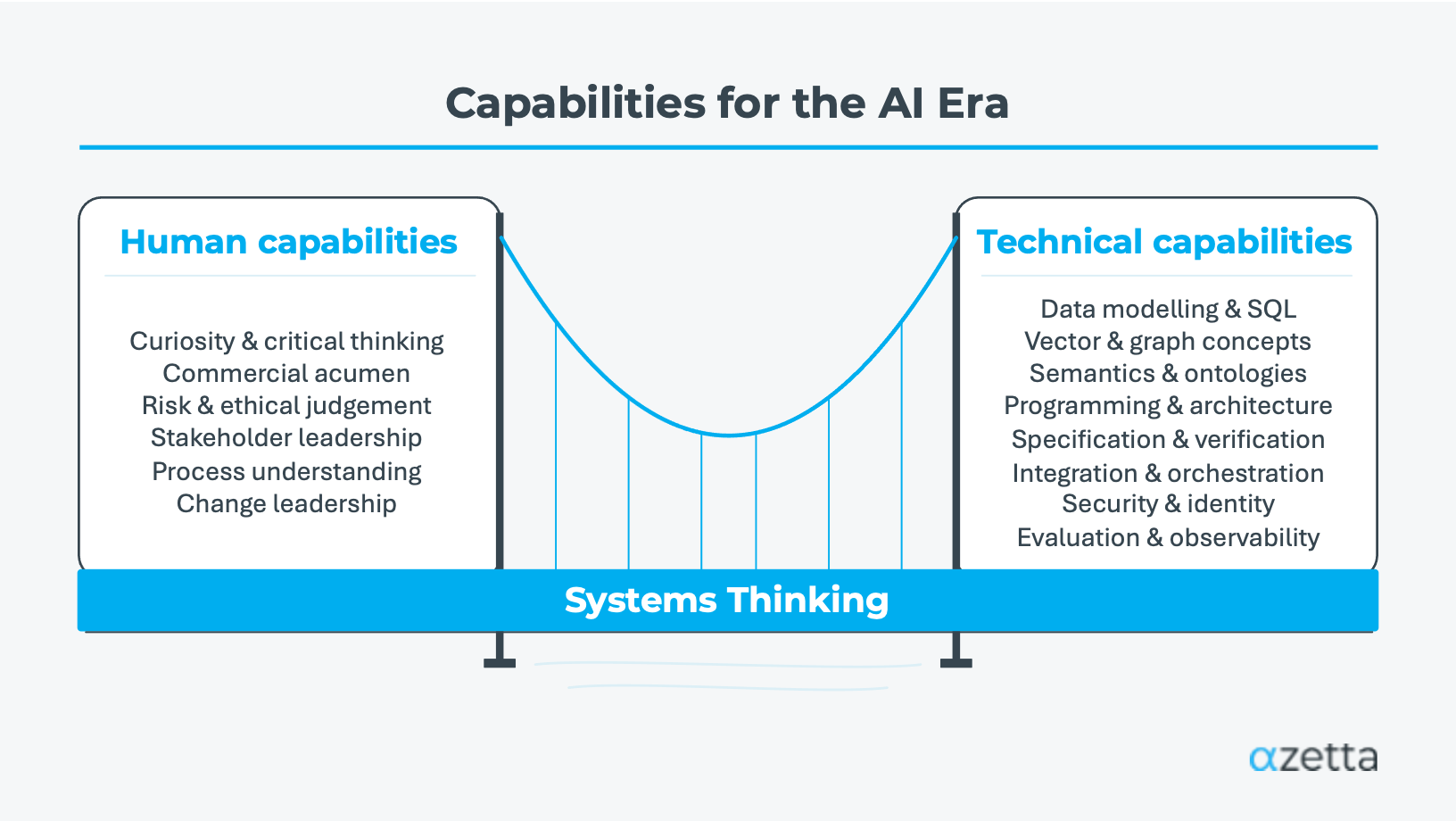
Figure 5: Connecting human and technical capabilities
Bridging the Consumption Gap requires both human and technical capability. Systems thinking connects the two, allowing organisations to frame better problems, design safer workflows, experiment with discipline and put AI into real work. These are complementary capabilities developed across a multidisciplinary team, not stages through which an individual must progress.
Source: AlphaZetta. © 2026 AlphaZetta. All rights reserved.
The human capabilities
I would like us to retire the phrase ‘soft skills’. There is nothing soft about persuading an executive team to change direction, helping people redesign work they understand intimately, exercising judgement under uncertainty or accepting accountability for decisions that affect customers and employees.
Curiosity and critical thinking allow people to test assumptions, inspect fluent output and ask what may be missing. Commercial acumen gives that judgement a purpose, while risk and ethical reasoning determine what should be automated, which errors are tolerable and where human accountability must remain. Stakeholder leadership creates shared ownership across organisational boundaries. Process understanding reveals how work is really performed, including the exceptions, incentives and workarounds that formal diagrams often miss. Change leadership turns that understanding into sustained adoption.
Deloitte describes a similar set of qualities as ‘enduring human capabilities’, including curiosity, resilience, connected teaming and emotional and social intelligence.31 These capabilities help determine whether technical capability becomes organisational capability.
The technical capabilities
The people designing, directing and governing AI need to understand what sits beneath the interface. Technical literacy means understanding enough to ask useful questions, recognise material risks and know when deeper expertise is required.
Data fundamentals remain essential: quality, completeness, timeliness, lineage and access. SQL supports the interrogation of structured data, while vector and graph concepts help explain similarity and relationships. Semantic modelling makes business meaning explicit, while ontologies formalise the relevant concepts and relationships.32 These disciplines help teams provide context that people and AI systems can interpret consistently.
In the mid-2000s, during my time at Business Objects, I overheard a colleague demonstrating Google’s search-trend data. She searched for Ajax, thinking of the web-development technique she was learning. Interest in India and the United States seemed unsurprising, but its popularity in the Netherlands puzzled her. As a football supporter, I had another explanation in mind.
I later used the example at conferences, showing the search results before revealing a photograph of Ajax’s football team. Ajax could mean a web-development technique, a cleaning product or the club that gave birth to ‘total football’. The same search term did not necessarily represent the same interest. My colleague brought a programming context; I brought a football context. Before interpreting the pattern, we needed to establish which meaning was relevant.
Language technology has advanced considerably since that conversation. The Transformer architecture introduced in the 2017 paper Attention Is All You Need uses self-attention to connect relevant parts of the text when constructing representations of its words. This helps a model distinguish an ambiguous term through its context. References to a goalkeeper or a JavaScript function, for example, point towards very different interpretations of Ajax.33
An AI system expected to act needs the relevant business definitions and context. A plausible interpretation can still lead it towards the wrong action.
Programming literacy also matters, even where AI writes much of the code. It involves understanding logic, control flow, state, interfaces, dependencies and what happens when something fails.
Specification becomes more important as natural language replaces some of the traditional interface to technology. A useful specification translates purpose into something that can be built and tested. It describes the intended outcome, relevant context, inputs, constraints, interfaces, exceptions and definition of success.
Verification asks whether the result meets that specification. It includes testing expected behaviour, challenging assumptions, examining edge cases, reviewing security and performance, and confirming that the system produces the intended business outcome.
Integration and interoperability become more significant as agents move from producing information to acting across systems. Security and identity define what an agent may access and which authority it is exercising. Evaluation and observability make it possible to test performance, trace actions, detect drift and recover when the system behaves outside expectations.
Systems thinking: the integrating discipline
Systems thinking connects human and technical expertise by examining dependencies, feedback and consequences across the whole process. A model improvement may create more operational delay. An automated task may move a bottleneck downstream. A new incentive may reduce data quality. An efficiency gain in one team may transfer cost or risk to another. A decision that appears technically sound may change customer behaviour in ways the original model did not anticipate.
As digital and data literacy increase, systems thinking becomes an achievable next step. Organisations can move beyond understanding individual technologies and begin understanding the systems in which those technologies operate. That means connecting architecture to process, process to behaviour, behaviour to outcomes and outcomes back to the system through feedback.
Without that discipline, organisations optimise components while weakening the whole. With it, business and technical specialists can reason together about dependencies, trade-offs and consequences.
Old disciplines, new interfaces
I earned my technical stripes at Capgemini in the late 1990s, when formal training preceded being trusted to build systems for clients. One of the disciplines we learned was pseudocode: describing the logic of an application before writing the implementation.
Pseudocode forced us to think about the inputs, decisions, sequence, exceptions, expected outputs and failure conditions. On a supply chain programme for General Motors, we applied that discipline to a three-tier application using Microsoft Transaction Server. We mapped use cases in Rational Rose and designed the responsibilities of the user interface, middle-tier services and database access layer before joining them together.
Years later, my industry and analytics teams undertook Business Process Model and Notation training so that we could connect our data products, analytics and decisioning services to the workflows in which they would be used. The tools and terminology changed, but the underlying discipline remained: understand the actors, activities, decisions, handoffs and exceptions before attempting to automate the process.
I am reminded of that training whenever I instruct AI. Whether I am working with a copilot or directing an agent, I need to make the purpose, context, inputs, constraints and success criteria clear. Complex work still needs to be decomposed, with assumptions and exceptions made visible.
The current enthusiasm for ‘vibe coding’ reflects a genuine shift in the interface to software creation. Natural language can now turn an idea into working code with remarkable speed, making prototyping and lightweight application development more accessible. Pseudocode imposed logic before implementation. Vibe coding can bypass that discipline when a broad intention moves directly into generated code without a specification or reliable verification.
At its best, AI-assisted development combines the accessibility of natural language with the disciplines of good engineering. At its worst, people generate code, run it and ask AI to repair it repeatedly without developing a mental model of the system they now own. Code that appears to work is not necessarily secure, maintainable or correct under conditions the original instruction did not anticipate.
GitHub makes a similar case in its guidance for AI-assisted development: the value of architecture, systems thinking, code review, testing and documentation increases as AI accelerates code production.34
The interface has changed. The discipline has not.
Build the team, not the mythical individual
A multidisciplinary team combines broad literacy with role-specific depth. Its members need enough understanding of one another’s work to make sound decisions together.
OECD’s 2026 policy brief states that fewer than one per cent of workers will need advanced AI-specific skills such as model development or specialised programming. A much broader workforce will need digital and data literacy, together with managerial and human capabilities such as problem solving, creativity and communication.35
Business leaders need enough technical literacy to understand material choices and risks. Technical leaders need enough commercial and organisational understanding to know why a capability is being built and how it will be used. Process owners need enough AI literacy to recognise what may be possible. Risk and governance teams need enough understanding of both the process and the technology to establish controls that support responsible action.
Some people will naturally span more of this capability than others. They are sometimes described as translators, although I have never found the term sufficient. Translation is part of the role, but so are listening, questioning, reframing, integrating and maintaining the connection between the original business purpose and the system ultimately deployed.
Our strongest RACE engagements at Teradata, and later the Agile Insights service offering we developed at AlphaZetta, brought together industry consultants, business specialists, data scientists, architects, engineers and customer process owners. The business problem, data, analysis, deployment path and value were considered together and articulated in our use case and roadmap templates.
That multidisciplinary way of working helped us cross the Consumption Gap in practice. Even when the analysis showed that the data was insufficient or the anticipated opportunity was not economically viable, the engagement had produced evidence and informed a decision.
The balance of skills changes across Assist, Create, Empower and Govern. Assist requires AI literacy, critical thinking and domain knowledge. Create adds review, provenance, intellectual property and knowledge management. Empower requires process modelling, specification, integration, testing, security and the definition of delegated authority. Govern adds verification at scale, observability, outcome management, exception handling and incident response.
Build capability through the work
Connect human and technical capability through a bounded piece of real work. Bring together the people who understand the process, the specialists responsible for building and governing the capability, and the person accountable for its outcome. Let them shape, test and assess it together.
This develops more than a solution. The process operator learns what the technology can and cannot do. The engineer learns why an apparently unusual exception matters. The business leader sees the dependencies beneath the promised outcome. The risk team gains evidence from a real process rather than debating a hypothetical one. The organisation becomes better at delivering the next use case.
Training still matters, but it should support experience rather than substitute for it. People need foundations in AI, data, risk, process, critical thinking and systems thinking. Specialists need deeper development in their respective domains. Leaders need to build multidisciplinary teams and create the conditions in which learning can move quickly into deployment.
Organisations bridge the gap by solving meaningful problems together, then reusing the language, evidence, trust and operating capability created through that work. This is how capability becomes consumption.
The bridge across the Consumption Gap is built by crossing it.
GO WIN
Leadership principles and practical guidance.
GO WIN stands for Get On With It Now. It may be one of the cheesiest acronyms you will ever hear, which is saying something in an industry that has never met an acronym it did not like.
GO WIN grew out of my frustration during the Big Data era, when I repeatedly saw organisations avoid meaningful action in two very different ways.
At one extreme, organisations filled newly christened ‘data lakes’, gave data scientists powerful analytical tools and assumed insight and value would emerge. The temptation was captured perfectly by xkcd’s Machine Learning.
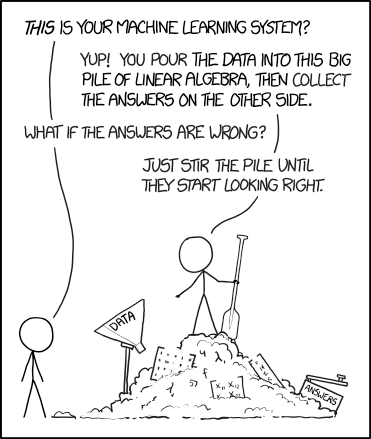
Figure 6: “Machine Learning”
Source: Randall Munroe, xkcd #1838. Reproduced under CC BY-NC 2.5.
Interesting results sometimes emerged, but could remain understood only by their creators. Technology teams lacked a clear deployment path, and the people expected to use the results had little basis for relying on them. The analysis lacked a route into a business decision or process.
Other organisations became trapped in analysis paralysis, prolonging architecture debates, committee formation and preparation. They waited for complete data, comprehensive governance and every stakeholder to agree before allowing work to begin.
GO WIN is a leadership mantra, not a delivery methodology. It calls for disciplined momentum: be ambitious about the outcome, create enough clarity to act, put capability into real work and use evidence to decide what happens next.
Be bold. Keep it simple.
Be ambitious about the outcome and precise about the first step. Choose something substantial enough to retain business attention, with a scope that people can explain, govern and deploy. Decide what matters, remove unnecessary complexity and make assumptions explicit. Define the smallest version that can test the hypothesis and establish whether the opportunity is worth pursuing.
Build compositionally: break the larger ambition into bounded capabilities that can be tested independently, combined where they add value and changed as conditions evolve.
This was particularly important when we were building the Aster Data business at Teradata. We wanted to dive in with our customers and discover what a new generation of MapReduce and graph technology could do for important problems in large, regulated organisations. My manager, who had previously led the professional services business, kept asking us for purpose, scope, success criteria, risk and a path to deployment.
At the time, that discipline could feel restrictive. In hindsight, it helped us move quickly and repeatedly. We kept peeling an opportunity back until we could explain why it mattered, what we would test, which data and technology we needed and how a successful result would be used. Clarity creates speed.
As a pure mathematician, I loved the elegance of that simplicity. As a former mathematics teacher, I also wanted us to show our working so that the results could be understood and trusted.
The first use case may improve familiar work, but it should also create a path towards something more ambitious: a redesigned process, a new service, a different operating model or a capability the organisation could not previously deliver.
Those structures became part of RACE and the Business Value Framework at Teradata, then evolved into AlphaZetta’s Agile Insights and Agile Deployment service offerings. They connected business purpose to outcomes, data, risks and deployment, creating enough clarity to move quickly without allowing discovery to become aimless.
Start with the use case
The AlphaZetta Use Case Design Template draws on Simon Sinek’s well-known Golden Circle principle.26 It begins with Why, moves through How and deliberately places the technology under What.
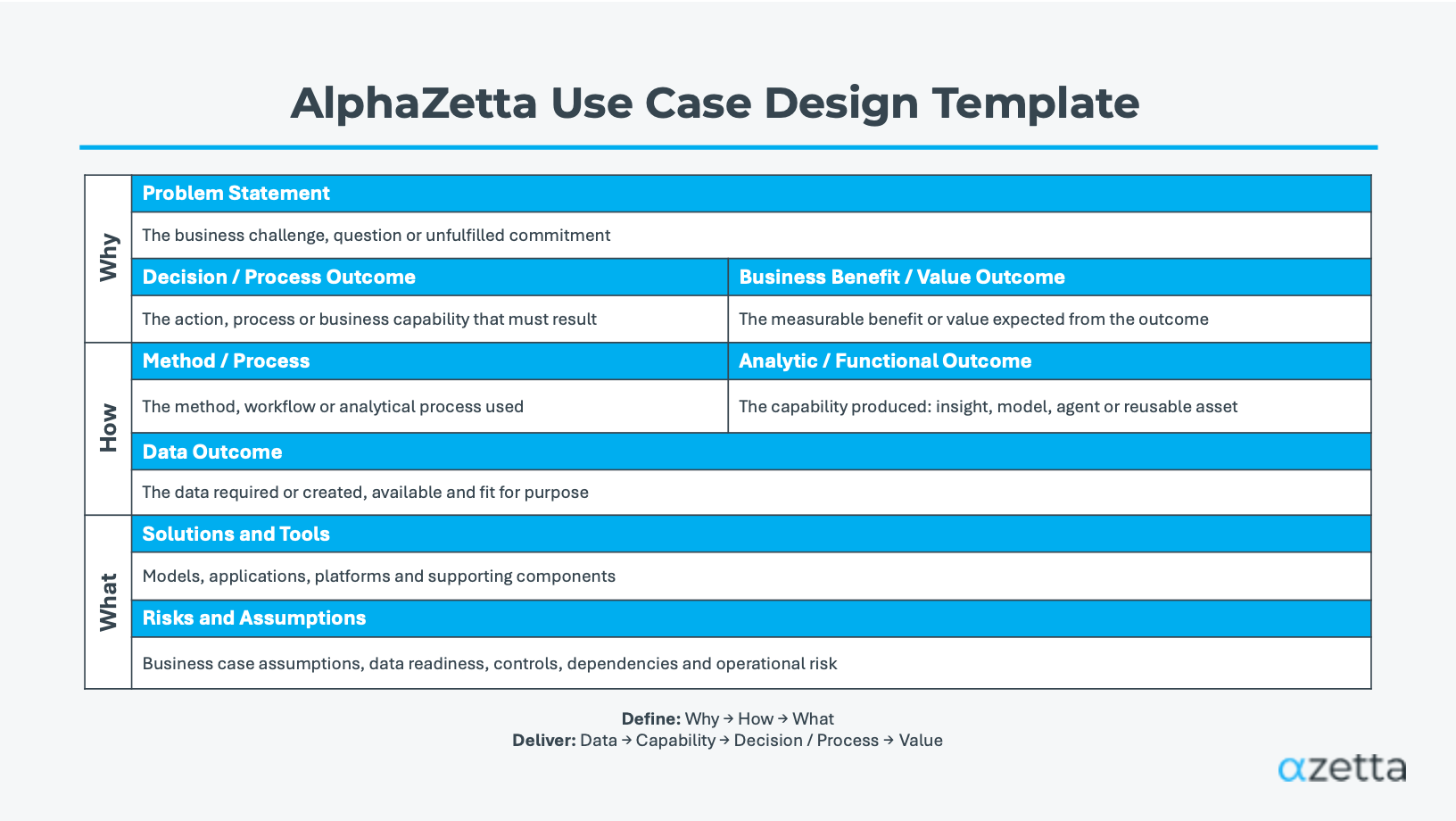
Figure 7: AlphaZetta Use Case Design Template
The AlphaZetta Use Case Design Template begins with business purpose, moves through capability and data, and places technology in support of the outcome. Use cases are defined top-down but deliver value bottom-up, from data and capability through to process and business value.
Source: AlphaZetta. © 2026 AlphaZetta. All rights reserved.
The Why defines the business problem, the decision or process required and the expected benefit. The How identifies the method, the analytic or functional capability and the data needed. The What specifies supporting technology. Record the risks and assumptions across the whole case.
Define the use case top-down and deliver its outcomes bottom-up. Test the connection at each step: data and capability must support a decision or process, and the resulting benefit must be measured. The paired labels analytic or functional outcome and decision or process outcome accommodate both analytical insight and working functionality, including an agent’s participation in executing work. Technical success still needs a route into business use before it can deliver the intended benefit.
Start with a problem that matters
Kendra Vant offered a particularly useful test in a 2024 conversation with Rohit Bassi on the People Quotient podcast: choose something consequential enough that getting it wrong would hurt, but sufficiently bounded that it would not endanger the business.36
A trivial problem rarely creates enough value, evidence or organisational interest to support what comes next. An existential process is a poor place to discover for the first time how people and AI should work together. The strongest starting points are bounded but consequential, with a recognisable owner, measurable outcome, manageable risk and safe fallback.
Worked example: From Voice of Customer to intelligent service treatment
One engagement with the B2C arm of a major corporation began with a familiar problem. The organisation collected large volumes of unstructured customer feedback through call-centre transcriptions and free-text responses to touchpoint surveys, but could not consistently convert that feedback into information that influenced customer treatment.
The broad assumption was that service preference would correlate strongly with age. Older customers were expected to prefer personal, human service, while younger customers would favour fast, low-touch digital interaction. The pattern existed, but the analysis showed enough crossover to make age an unreliable proxy for an individual customer’s actual preference.
The use case can be expressed through the AlphaZetta template.
Problem statement
The organisation holds valuable customer feedback but cannot consistently translate it into reusable customer attributes or more appropriate service treatments. As a result, interactions may not reflect individual preferences, creating avoidable friction and increasing retention risk.
Decision or process outcome
Use new customer-preference attributes to select customer treatment, campaign and service pathways.
Business benefit
Improve the relevance of customer interactions, reduce service friction and strengthen retention, cross-sell and upsell activity.
Method / Process
Process existing call transcriptions and free-text survey responses using Latent Dirichlet Allocation and related text analytics to identify topics, loyalty characteristics and service preferences.
Analytic / functional outcome
Reusable classifications that distinguish, among other things, customers who value a product, the broader brand, fast low-touch service or more personal human interaction.
Data outcome
Obtain customer feedback suitable for validating the classifications and testing their contribution to downstream propensity models. Link the resulting attributes appropriately to customer records and establish access to the data required for operational use.
Solutions and tools
The enterprise analytics platform processed the text, generated classifications and wrote the new attributes into the customer analytic record.
Risks and assumptions
Data ownership, contractual access, privacy, representativeness, interpretation of topics and the consequences of misclassification all had to be understood.
The most significant early constraint was not analytical. A third party controlled much of the required customer feedback under an existing contract. The team combined synthetic data with a sample the customer already held from earlier analytical testing. This allowed processing work to progress and clear candidate classifications to be defined. Their contribution to the customer propensity models remained to be tested.
Access to additional customer data through the third party allowed the team to test and refine those classifications and develop new ones. This established their functional usability and enabled testing of their contribution to downstream propensity models. That value testing remained part of the iterative work before production, with better customer understanding and service as the ultimate aim.
The models were subsequently run across the wider available customer population. The resulting attributes were stored in the customer analytic record for use by downstream retention, cross-sell and upsell models and campaigns. The success criteria were met and the process was productionised, although the customer did not share detailed financial results.
That sequence is GO WIN in practice: progress what the available data supports, make clear what remains unproven and extend testing as access improves. Preparation, functional validation and value testing each support a different decision.
Agentic-era extension: intelligent routing and resolution
Today, the same capability could sit directly inside a service workflow. An agent could receive a request through voice, text, email or a portal, transcribe it where required, identify the customer’s intent and retrieve the service-preference attributes held in the customer record.
It could then create or enrich the service ticket and recommend an appropriate route: automated resolution, a specialist human adviser, a particular service team or a safe default where confidence is insufficient. Permission to select and execute that route would require a further judgement about Automation Tolerance.
This is a possible extension, not part of the original deployment. It shows how the earlier analytical insight could become context for an agent participating directly in the service process.
A public example: post-incident review
One Australian organisation described post-incident reporting as an early use of ServiceNow’s Now Assist. An agent prepared initial drafts for internal IT issues, with incident information checked for potentially sensitive content before it reached the agent.37
For a use case like this, I would define the first scope as gathering relevant incident records and preparing a draft for human review. I would measure preparation time alongside completeness, factual corrections and reviewer effort. A faster draft should still support an accurate account of what happened. Creating knowledge articles or initiating follow-up work would be possible extensions, each requiring its own evidence and permission. This gives people a useful capability to assess before deciding how much further to delegate.
Define the evidence before you begin
I expect technology vendors to help define the customer’s problem before offering a pilot. Assembling a team around a product and hoping a demonstration will reveal its business case leaves the purpose of that investment unresolved. The vendor should connect its capability to a decision the customer needs to make and evidence the customer can use.
A Proof of Concept asks whether an idea, function or technical capability can work. A Proof of Value should establish whether the knowledge or capability produced is useful enough to inform a decision, justify action or progress towards deployment.
That is different from realising the value. Financial returns may emerge later. The team running an experiment can establish usefulness without controlling the process change, deployment or investment needed to convert it into revenue, cost reduction, avoided risk or another measurable benefit. The decision or process outcome specifies what will change; the value outcome specifies the benefit expected from that change.
Success criteria should recognise both positive and negative findings. Knowing that something works can be valuable, as can discovering that the data is insufficient, the economics are weak or the process is not ready. Those findings need to answer a clearly framed hypothesis and inform a decision.
A proof of value without a value hypothesis is a proof of concept with a more ambitious name.
Before starting, an organisation should know which problem is being addressed, who owns it, how the process performs today, what outcome is expected, how it will be measured, what evidence would justify deployment and what evidence would justify stopping. Discovery exists because uncertainty remains, but the organisation should still know what it is trying to learn and which decision the evidence will inform.
Conclude the engagement with an explicit decision to proceed, revise, defer or stop, and assign responsibility for acting on that decision. The real failure is a pilot that ends with an impressive demonstration and no conscious decision about what happens next.
Stand up and sprint
Aim the first sprint at evidence, learning and value, with authority proportionate to what the organisation can safely delegate.
Peter Carr captured this well in his article Have You Tried Our New AI Agent?: help organisations to ‘lay track, not just stare at the horizon’.38 The North Star matters, but people also need to see a credible route from the work they are doing today to the transformation they are being asked to imagine.
Business leaders also deserve a practical answer to the timing question. The following indicative cadence draws on my experience of these engagements. Actual timings depend on the use case, data access, risk and organisational readiness.
| Stage | Purpose | Indicative timing |
|---|---|---|
| Stand up | Define the problem, owner, outcomes, hypothesis, data, team, risks and success criteria | Days to about one week |
| First sprint | Test feasibility, validate the analytic or functional outcome, assess value and make a conscious decision | As little as two weeks for a prepared, bounded case; commonly four to eight weeks of work |
| Overall elapsed time | The above plus contingency for data access, stakeholder availability and organisational constraints | Historically often six to twelve weeks in total |
| Agile Deployment | Engineer, integrate, secure, test, operationalise and support adoption | Approximately four weeks to four months or more |
| Scale and govern | Reuse assets, expand authority, monitor outcomes and adapt | Ongoing |
Table 1: Indicative GO WIN delivery cadence
Source: AlphaZetta
Modern cloud provisioning, improved data platforms and better enterprise data access can shorten the first sprint. Production still requires engineering, integration, security, testing, operating support and organisational change.
The Voice of Customer analysis took approximately four weeks once the data was available. Contractual access extended the elapsed time. A fast analytical sprint and a longer route into operational use can coexist.
Stand up in days, seek evidence in weeks, and give production the engineering and organisational commitment it requires.
Get on with it now
GO WIN turns a plan into the next accountable step. Define something valuable, identify the owner and make clear which evidence will determine what happens next. Bring business and technology together, put the capability into useful work and use the experience to pursue the larger ambition.
Be bold in the outcome, simple in the design and composable in the way you build. Stand up and sprint towards evidence and value. Lay track towards the larger transformation. Most importantly, get on with it now.
Data, models, integrations, regulations and business conditions will continue to change. Sustaining the momentum created by GO WIN requires the organisation and its AI systems to adapt without losing control or trust.
Get on with it now, but design for what changes next.
Designing for Volatility
How to sustain reliable AI as conditions change.
Production is not a steady state.
An AI agent can work exactly as intended on Monday and begin making poor decisions on Friday even though nobody has changed the application code. The model endpoint still responds. The workflow remains available. The operational dashboard may even remain green. Yet the overnight data feed has failed, a product hierarchy has changed, a retrieval source has become stale, a system of record has changed its schema or customer behaviour has moved beyond the assumptions on which the capability was tested. The system is running, but it is no longer operating under the conditions in which it was trusted.
This is the defining architectural challenge of the agentic era. Agentic systems combine repeatable processes with probabilistic components whose behaviour changes with data, context, instructions and tools. Reliability requires detecting change, understanding its consequences and adapting without losing control.
NIST makes this point directly. AI systems can require more frequent maintenance because of changes in data, models and concepts, while third-party components, stale information and difficulties reproducing behaviour introduce risks that differ from conventional software.11
That requires an architecture in which change can be isolated and components replaced without rewriting the business process. Material changes also require a review of the evidence supporting delegated authority.
Production changes the experiment
At AlphaZetta, our Agile Insights and Agile Deployment service offerings separate discovery from engineering for repeatability, integration, control and scale. Discovery establishes whether a capability is valuable and feasible. Deployment brings it into accountable operation; testing continues as its conditions change.
Production changes the questions: does the capability still work, under which conditions, for whom, at what cost and with what unintended consequences? Genuine experimentation continues through evaluation, monitoring, controlled change and, where necessary, replacement. It is experimentation under operational accountability.
Drift is not one thing
Data drift describes a change in the distribution of inputs reaching a model. Concept drift describes a change in the relationship between those inputs and the outcome being predicted.39 Model decay is the visible consequence when performance deteriorates because the assumptions on which the model relied no longer hold.
A missing data feed, a changed unit of measure, an incomplete file or a corrupted record is not necessarily drift in the statistical sense. It may be a data-quality or integrity failure. Operationally, however, both can produce the same result: a model or agent acts with context that is stale, incomplete or misleading.
Generative and agentic systems add further forms of volatility. The underlying model may change. The prompt, retrieval corpus, tool description or policy may be revised. An external API may alter its behaviour. A vendor may deprecate a model version. A new agent may begin writing information into a system that another agent later consumes. The model may be unchanged while the system around it has drifted.
Generative AI can also produce fluent but false content, often called hallucination and described by NIST as confabulation.15 An incorrect response alone does not establish model decay. The team still needs to determine which assumptions or components failed.
These are all issues regularly faced in the business world. One of my favourite illustrations, however, comes from Game of Thrones. My former colleague Dr Clement Fredembach, who was in my team at Teradata, processed approximately 1.5 million words from the first five A Song of Ice and Fire novels. He extracted characters and relationships to build a changing social graph, then used Loopy Belief Propagation to estimate who would die next from limited ground truth about who was alive or dead.
The method was remarkably effective in the earlier books. It placed Eddard Stark and Renly Baratheon at the top of the relevant death predictions shortly before their deaths. Later, however, its performance weakened. The story became less structured, the graphs became less dense, more people died (everybody does!), the ground truth for death kept increasing and the ground truth for who was genuinely safe became increasingly difficult to define. Clement then tested the Andersen–Gill event-driven survival model, an extension of the Cox proportional-hazards approach, and found that it was the better predictor at this stage of the story.40
The suitability of a model depends on the structure of the environment, the quality of the ground truth and the assumptions built into the method. Loopy Belief Propagation had not suddenly become mathematically unsound. The world it was describing had changed.
When the model changes the world
Some models decay because the environment changes independently. Others contribute to the change themselves.
Predictions influence decisions, and decisions influence the data on which later predictions are trained. Research into performative prediction describes precisely this effect: when predictions guide action, they can alter the population or behaviour they are intended to predict, creating a new distribution and potentially undermining their own assumptions.41
There is a related feedback problem in human systems, described decades ago by Campbell’s Law. Originally formulated in the context of social policy, Campbell’s Law states that the more a quantitative social indicator is used for decision-making, the greater the pressure to corrupt it and distort the social processes it is intended to monitor.42
Consider Net Promoter Score (NPS). It can be a useful signal of customer sentiment, but once targets, bonuses and management attention depend heavily upon it, the metric becomes vulnerable to manipulation. Staff may influence when surveys are issued, select which customers receive them or pressure respondents to give a perfect score. The metric improves while the customer experience stagnates or declines.
Empirical research has also challenged claims that NPS is uniquely superior to alternative customer measures.43 Anchoring an organisation’s strategy to a single, easily gamed metric can ultimately weaken the relationship between the measure and the outcome it was intended to represent.
An agent can optimise a target in ways that undermine the intended outcome. This is specification gaming.44 If an agent is instructed to improve resolution time, it may close work quickly while transferring unresolved complexity elsewhere. If the target is deflection, it may prevent a customer from reaching a human even when that would produce the better outcome. If the target is cost, it may choose a cheaper path that increases rework or risk.
Preserve the underlying events, sampling logic, process context and outcome measures needed to judge whether the target still represents what the organisation values. Observe the consequences of the agent’s actions alongside its score.
Separate the predictable from the probabilistic
Start by deciding where probabilistic behaviour is required. Some work benefits from interpretation, inference and flexibility under ambiguity. Other work requires repeatability, precision and explicit rules.
That distinction should shape enterprise architecture. Deterministic software remains well suited to authentication, financial limits, schema validation, approval thresholds, calculations, duplicate-transaction prevention, routing constraints and other rules that can be specified precisely. Probabilistic AI is valuable when the work requires interpretation, classification, generation, prioritisation or judgement across incomplete information. The larger architectural opportunity is orchestration: combining probabilistic, deterministic and human capabilities so that each is applied to the part of the process it is best suited to perform.
Not every problem needs an LLM. Not every LLM call needs a workflow. Not every workflow needs an agent.45
A customer-service agent may interpret an ambiguous request and identify the likely intent. A deterministic rule can then verify identity, enforce a refund limit and record the transaction. An agent may propose the next action, while a workflow determines which approvals are mandatory.
Neuro-symbolic approaches combine learned capabilities with explicit symbolic reasoning. A neural or generative component can interpret language, recognise patterns and translate an ambiguous problem into a structured representation. A symbolic component can then apply explicit rules, constraints, calculations or optimisation before returning the result to the surrounding workflow.
A 2026 robotics study makes this division of work concrete. Researchers tested a simulated robot on Towers of Hanoi, a block-stacking puzzle governed by explicit rules. Their neuro-symbolic system used a symbolic planner to select the sequence of moves and learned controllers to execute them. On the three-block task, it achieved 95% success, compared with 34% for the best vision-language-action configuration tested, while consuming less energy during both training and execution.46
For me, the significance is architectural. The study gives a concrete reason to evaluate combinations of capabilities against a defined task. In enterprise work, that means deciding where learned interpretation is useful, where explicit rules or planning are appropriate, and how the complete system performs against the required outcome and resource constraints.
The future enterprise AI architecture is therefore unlikely to rely on a single general-purpose model. It will combine models of different sizes, deterministic software, symbolic reasoning, retrieval, structured workflows and human judgement.
The same decomposition applies to the work itself. A workflow may contain activities with very different levels of Automation Tolerance. Breaking it into bounded capabilities allows the organisation to automate one part, supervise another and retain human judgement where the consequences or social meaning require it.
Build for replacement
My background in object-oriented and component-based development strongly shapes how I think about this architecture. A well-designed component exposes what it does through a contract without requiring every consumer to understand how it does it. That principle becomes even more valuable when the component’s internal behaviour is probabilistic. The contract creates a deterministic boundary around something whose internal behaviour may not be deterministic.
An AI component might be free to interpret unstructured text in different ways, for example, while still being required to return an output that conforms to a defined schema, uses permitted values and remains within an explicitly bounded authority. The contract does not guarantee that the interpretation is correct, but it gives the surrounding system something that can be validated, tested, rejected and replaced.
The unit of change should be the component, not the entire business process.
Data access, retrieval, model selection, prompts, policy, tools, orchestration, workflow and user experience should not be fused into one opaque application. They should be versioned, tested and observed independently, with clear interfaces between them. If a model degrades, it should be possible to test and introduce a replacement without rewriting the workflow. If a data product changes, its contract should reveal the change before downstream agents quietly begin behaving differently. If a tool becomes unavailable, the process should have a fallback rather than collapsing.
None of this is fundamentally new software engineering. Modularity, loose coupling, encapsulation and explicit interfaces have been used for decades to stop changes in one component destabilising an entire system. What is new is the degree of variability we are now placing behind those interfaces. Research from Google has made a similar point in machine learning, where tightly coupled data, models and surrounding components can accumulate technical debt and become increasingly difficult to change independently.47
Composability is the practical ability to test, replace and recombine capabilities without destabilising the wider system. The business process should depend on the capability it needs, not the model currently providing it.
Traditional APIs remain fundamental, but the agentic era also introduces open protocols intended to make tools, context and agents more portable. The Model Context Protocol (MCP) standardises how AI applications connect to external systems,48 while Agent2Agent (A2A) provides a common interaction model through which independent agents can discover capabilities, exchange information and coordinate tasks.49 These protocols can reduce brittle, bespoke integration, but they do not resolve the harder architectural questions.
A shared syntax does not guarantee a shared semantic meaning. Organisations still need common definitions, versioning, identity, authorisation, provenance, error handling and an understanding of which agent performed each action and who remains accountable for it. Interoperability must preserve meaning, authority and control when a component changes.
Automation Tolerance describes how much authority an organisation is prepared to delegate; time-bound authorisation helps ensure that yesterday’s tolerance does not quietly become tomorrow’s permanent permission.
Design data for failure
Design for data that arrives late, incomplete, inconsistent or wrong. Those conditions must inform both the technical architecture and the business process.
Every consequential data product should therefore have an explicit contract covering schema, freshness, completeness, lineage, ownership and acceptable quality. The system should know which version of the data it used and whether the required thresholds were met. Inputs that fail those checks should be quarantined, rejected or routed to a safer path. A field can keep its name and format while its business definition changes; those semantic changes also need explicit management.
Retrieval sources and tool responses need the same checks. Documents can be stale, duplicated, incomplete or manipulated; a technically valid tool response can still be unsuitable evidence for the proposed action. NIST recommends continuing evaluation, incident processes and deactivation where necessary.11,15
Graceful degradation is a business-design choice as much as a technical one. If a preferred recommendation is unavailable, the process may use a standard offer. If confidence falls below an agreed threshold, the agent may route the work to a human. If a data source is stale, the system may become read-only. If identity cannot be verified, the action should stop.
An autonomous system must be able to say, ‘I do not have sufficiently current or reliable information to act’, and withhold the action. Continuing regardless is a failure of control.
Secure the chain from context to action
An agent connects information, interpretation and action. A malicious instruction embedded in retrieved content can therefore become an operational security problem when the agent acts through a legitimate account. Data governance, AI assurance and cybersecurity must address that chain together. Protecting the model without protecting its data, tools and execution environment leaves material parts of the system exposed.51
Agents should be managed as identifiable software entities, with a named owner, an explicit purpose and a record of their dependencies and delegated authority. Their identities and audit trails should distinguish their actions from those of the people they serve. Access should be limited to the data, tools and operations required for the task, with a defined lifetime and a means of revocation.52
Instructions and model-level safeguards remain useful, but consequential limits should also be enforced outside the model. Tool interfaces, identity services and downstream applications should constrain access, validate actions and enforce approval requirements. The agent may propose an action; it should not be the sole judge of whether it is authorised to perform it.51
These controls must follow the capability as it changes. A new tool, broader data access, a revised workflow or a different model can change the risk of an agent that was previously approved. Governance must connect those changes to renewed evaluation and, where necessary, revised authority.
Observe the work, not just the model
Traditional operational monitoring asks whether a service is available, how long it took and whether an error occurred. Those measures remain necessary, but they are insufficient for an agent that may choose different paths, call several tools, modify state and trigger other systems.
Camunda’s Jakob Freund makes a related point in his discussion of the ‘automation ceiling’: individual agents may improve their tasks while the end-to-end process remains fragmented. He argues for a shared view of each case across the people, agents and systems involved.53
Agentic observability needs to reconstruct the work. What request did the agent receive? Which instructions, model and data versions were used? Which tools were available? What did it call? What did those tools return? Which decisions were made? What actions followed? Where did a human intervene? What did the task cost, and what business outcome resulted?
OpenTelemetry’s generative-AI conventions provide a useful common language for tracing model and tool activity across this chain.54 But technical traces alone are not control.
In a presentation to EY in late 2024, I described retaining a human reference path alongside autonomous execution. A proportion of comparable work continues to be performed by people, with the inputs, decisions, actions, hand-offs, exceptions and outcomes captured and codified.
The agent’s work can then be compared continuously with those human reference traces. Similarity does not prove that the agent is correct, nor does difference prove that it is wrong. What matters is whether its behaviour meets the task’s requirements and remains within authorised boundaries. Material outliers can trigger investigation or intervention and, for sufficiently consequential work, cause the task to be paused and routed to a human before the action is completed.
The proportion of work flowing through each path should reflect the activity, its potential consequences and the accountability retained by people. A software-provisioning demonstration I used at ServiceNow showed an agent responding to a request for screen-recording software by selecting Camtasia from an approved list and provisioning an available licence. Reclaiming a licence assigned elsewhere or initiating a purchase were possible extensions I discussed, not steps demonstrated. Each would require its own decisions about eligibility, approval and spending authority.
Figure 8 illustrates why this is an activity-level judgement, not a ranking of business functions. Provisioning an approved application differs from changing privileged access to production systems. Retrieving a recorded leave balance differs from determining an entitlement or altering payroll. The scope of autonomous execution, human involvement and reference sampling should be calibrated to the particular activity and reassessed as evidence, controls and operating conditions change.
The balance between the human reference path and autonomous execution becomes a practical expression of Automation Tolerance.
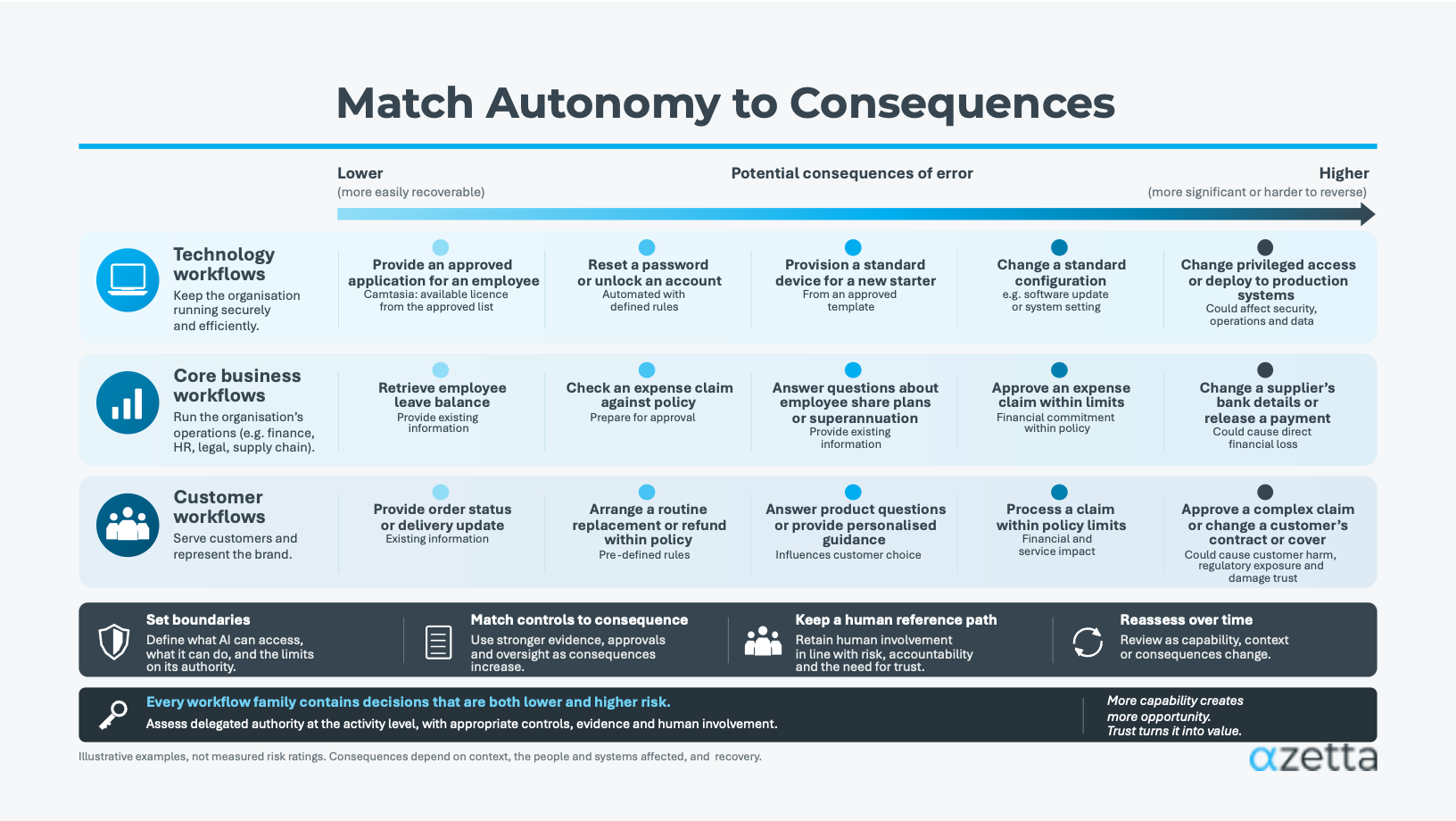
Figure 8: Matching autonomy to consequences
Activities within technology, core business and customer workflows can have very different consequences when something goes wrong. Delegated authority should be assessed at the activity level, with evidence, controls and human involvement proportionate to the potential harm and ability to recover. The examples are illustrative, not measured risk ratings or fixed prescriptions for autonomy.
Source: AlphaZetta. © 2026 AlphaZetta. All rights reserved.
Behavioural comparison is only part of the control. It does not replace the permissions, limits or approvals needed before a consequential action is taken.51 Technical events must also be connected to business meaning. A trace may show that a tool call succeeded, but the organisation still needs to know whether the correct customer record was changed, whether a policy was breached, whether a human overrode the decision and whether the expected outcome was achieved.
An operational control tower brings together the evidence and controls needed to oversee AI-enabled work. It should show which path the work followed, what outcome resulted and how autonomous behaviour compares with relevant human reference patterns. It should also connect activity to identity, versions, delegated authority and budgets, surface exceptions and incidents, and give the organisation the means to intervene or adjust authority as the evidence changes. This capability can span connected systems, with permissions and action limits enforced by the services that execute the work.
Observability without the ability to intervene relegates the organisation to spectator rather than controller.
Scale the outcome, not the uncertainty
Scale changes both the economics and the consequences of agentic systems because the path from request to outcome may vary each time. A single task may require one model call or twenty. An agent may succeed immediately, retry a tool, enter a loop, expand its context or delegate work to another agent. Cost and latency can therefore vary considerably even when the original request looks similar.45
The economics of the underlying models are themselves extraordinarily volatile. Stanford’s 2025 AI Index reported that the cost of querying a model with GPT-3.5-equivalent performance on the MMLU benchmark fell from $20 per million tokens in November 2022 to $0.07 by October 2024, a reduction of more than 280 times.1
Lower unit prices do not guarantee lower system costs. An agent using a cheaper model may still consume longer context, make more calls, invoke more tools, retry failed actions or delegate work across several agents. Usage can grow faster than the cost per token falls.2
Measure cost per successfully completed business outcome, including retries, tool usage, human review, failure recovery and the operational cost of errors.
Agents should operate within explicit budgets for time, tokens, spend, tool calls, retries and concurrency. Timeouts, circuit breakers and escalation paths should stop uncontrolled loops. Smaller or specialised models can handle bounded tasks, while more capable models are reserved for cases that justify the additional cost. Deterministic filters, symbolic reasoning, caching and asynchronous processing can reduce unnecessary generative inference.
Cost also acts as an operational signal. A sudden rise in tokens, retries or tool calls may indicate a changed prompt, degraded model, ambiguous input, failing integration or an agent pursuing an unintended trajectory.
At scale, repeated errors, uncontrolled loops and small cost variances can become operational incidents and budget problems. The same composability that enables innovation must be accompanied by limits that contain propagation.
Today’s premium capability may become tomorrow’s commodity, while a smaller, specialised or hybrid system may overtake the current leader for a particular task. That is another reason to make the architecture composable rather than bind the business process tightly to whichever model happens to lead today.
Keep testing after deployment
A volatile system requires a continuing research and development mindset. Offline evaluation remains useful, but it must be complemented by testing in the context where the capability will operate.
New models, prompts, tools and data sources should be evaluated against representative tasks and known edge cases. Changes can be introduced through shadow operation, canary releases or champion-and-challenger comparisons. Retain human approval for consequential actions where the evidence and risk require it. Rollback and deactivation must be designed before they are needed.
Research such as Reflexion shows how an agent can use retained feedback to change subsequent behaviour without updating the underlying model’s weights.55 Where an agent retains memory or modifies its operating instructions, those changes also need provenance, evaluation and a recovery path. Adaptation should not silently broaden the authority under which the agent operates.
Evaluate process completion, business outcomes, fairness, security, latency, cost, recovery and the effect on the people who use or experience the system. Ground truth may arrive late, so leading indicators and proxy measures will be needed, but Campbell’s Law reminds us not to confuse the proxy with the outcome.
Designing for volatility means preserving evidence, accountability and trust as data, models and operating conditions change. Clear component contracts, dependable data, bounded authority, observable outcomes and tested recovery paths allow the organisation to adapt while sustaining the work. Continuing evaluation determines when a capability remains fit for purpose and when it needs to change.
The durable advantage belongs to the organisation that can change models, data and workflows without breaking the business or losing trust.
Putting AI to Work
The leadership choices that turn capability into value.
By the time this paper is published, some of the technology described within it will already have changed. Models will have improved, interfaces will have shifted and capabilities that once appeared expensive may have become commonplace. I find that prospect exciting. Designing for change is how organisations remain able to take advantage of what becomes possible next.
The durable question is whether organisations can integrate AI into real work, delegate appropriate authority and convert the result into value without losing control or trust. The Consumption Gap is the distance between available capability and what an organisation is willing, able and ready to put to use.
Technical trustworthiness creates the foundation. Human trust determines whether people and organisations are willing to rely on the system. Trust earns permission, while Automation Tolerance determines how far that permission extends. Assist, Create, Empower and Govern describe a progressively deeper role for AI, from helping an individual perform a task to operating with bounded autonomy across enterprise processes.
The stages are not a timetable or a march towards maximum autonomy. Different activities warrant different degrees of delegation. Maturity lies in selecting the appropriate role for AI and revisiting that choice as evidence, risk and operating conditions change.
The early gains from Assist and Create are real. They can improve productivity, quality, knowledge and employee experience. They also allow people to experience AI in work they understand, learn where it performs well and participate in imagining what should happen next. Those early stages create the evidence, trust and organisational capability needed for more ambitious transformation. The destination remains redesigned work, new services, different operating models and value that did not previously exist.
Measure what changed
Measurement must begin before AI changes the process. An organisation needs to understand how the work performs today if it intends to claim that the work performs better tomorrow.
That means establishing a credible baseline for the outcome being pursued. Depending on the use case, it may include cycle time, throughput, cost, quality, rework, risk, customer or employee experience, human effort and the frequency or consequence of failure. Where a clean baseline is unavailable, the organisation may need a matched comparison, control group, historical benchmark or period of shadow operation.
Use model accuracy, token consumption, agent utilisation and automated-task counts to explain performance. Judge success against the intended business, customer or public outcome.
The Australian Government’s 2024 trial of Microsoft 365 Copilot offered an encouraging example of AI supporting everyday work. The tool was made available to more than 7,600 staff across over 60 agencies. In the post-use survey, 69% of respondents reported completing tasks faster and 61% reported improved work quality. Around 40% reported being able to redirect time towards activities such as mentoring, strategic planning and engagement with colleagues and stakeholders.56
For me, these are gains worth building on. Assist creates value when AI helps people do useful work well; Create extends that value when reviewed outputs become reusable organisational assets. Leaders should build on that progress with deliberate choices about the capacity released: more time for complex cases, better support for colleagues, development of new skills and more attentive service. Then measure what changes for employees and the people they serve.
IKEA remains one of my favourite examples of using AI to create room for people to contribute in different ways. In 2023, Ingka Group reported that, as its chatbot handled simpler enquiries, thousands of call-centre employees had been reskilled in remote interior design, digital sales and more complex customer support.57
Part of its appeal to me is personal. When my father downsized, an IKEA design team helped make what could have been a difficult transition considerably easier. That experience gave me a lasting appreciation of what this kind of service can mean to the person receiving it.
Extending those gains requires a conscious decision about how released capacity will be used, supported by the skills and process changes needed to make that choice work. Benefits also arrive on different clocks. Operational improvements may appear quickly. Organisational learning, reusable capability and trust develop through repeated use. Wider financial, customer or public benefits can take longer to emerge and demonstrate.
That conversion requires ownership. The team running an experiment may prove that a capability works and is useful, but it cannot always control whether the organisation changes the process, reallocates capacity or makes the investment required to realise the value. The decision or process outcome must therefore be explicit, together with the person accountable for acting on the evidence.
Build the capability to consume
Start with the test Kendra Vant offered on the People Quotient podcast: a business problem that is bounded enough to learn from safely and consequential enough to matter.36 Define what should change across the four outcomes: fit-for-purpose data, a reliable insight or working capability, a decision made or a process changed or executed, and a benefit that can be observed and measured. Establish the hypothesis, owner, success criteria, risks and safe fallback before selecting the technology.
Bring together the people who understand the work and the people who understand the technology. Include those who operate the process, those accountable for the outcome, and the specialists responsible for data, engineering, security, risk and change. The people affected by the capability should participate early enough to shape it.
Choose the simplest appropriate combination of capabilities. Use deterministic software where precision and repeatability are required. Use probabilistic AI where interpretation, generation or judgement across incomplete information creates value. Retain human judgement where the consequences, ambiguity or social meaning demand it. Orchestrate those elements around the business outcome.
Test the hypothesis through disciplined discovery. Determine whether the capability is feasible, valuable and deployable. Make a conscious decision from the evidence, including the decision to stop when the data, economics or risk do not justify proceeding. If the work progresses, engineer it for production: build compositionally, integrate it properly, secure and observe it, and provide the operational support and organisational change required to sustain it.
Then keep testing. For probabilistic AI, production is experimentation under operational accountability. Continue to test the data, models, costs and behaviour, and retain the ability to replace components, adjust delegated authority and intervene. That includes a means to stop execution.
This is how people develop calibrated trust. They see the capability perform real work, understand its limitations, challenge its output and influence how it develops. As evidence accumulates, permission may expand. When performance deteriorates or the risk changes, it may contract again. Over time, that learning becomes an organisational capability in its own right.
The organisational advantage
Access to a leading model may confer a temporary advantage. The more durable advantage is organisational: the ability to learn faster without sacrificing accountability, reuse what has been built and adapt as conditions change.
This requires leadership. Leaders must be ambitious about the outcome while remaining disciplined about the path. They must make trade-offs, assign accountability and create enough clarity for people to act. They must protect experimentation from becoming theatre and governance from becoming an excuse for inaction.
The argument comes back to three lines:
Technology creates capability.
Trust creates consumption.
Consumption creates business value.
The lasting advantage lies with organisations that learn to trust AI appropriately, integrate it into useful work and measure what changes. Be bold in the outcome and precise about the next step: choose the problem, name the accountable owner and agree what evidence will justify proceeding. Get on with it now.
Frameworks and Practical Tools
This appendix provides a reference to the principal terms, frameworks and practical disciplines used in the paper. Definitions describe their use here; they are not intended to replace formal standards or the fuller explanations in the relevant chapters.
The practical checks can be used when defining an opportunity, deciding what authority to delegate and reviewing whether the resulting capability has created value. Research sources and practitioner attributions appear in the main text and Appendix B.
A1. Core definitions
The Consumption Gap
The difference between what AI can produce and what an organisation can confidently integrate into its everyday decisions, processes and operations.
The gap concerns willingness, ability and readiness to use a capability, not simply whether the technology has been deployed. Consumption ranges from useful individual assistance to AI participating in organisational processes under defined authority.
See Chapters 1–3 and Figure 1.
Trustworthiness, trust and calibrated trust
Trustworthiness describes properties that make a system worthy of reliance, including reliability, safety, security, transparency and accountability.
Trust describes a person’s or organisation’s willingness to rely on that system in a particular context and accept some vulnerability to the outcome. A system can be trustworthy without being trusted, or trusted beyond what its performance justifies.
Calibrated trust means that confidence is proportionate to the available evidence, the task and the consequences of failure. The objective is appropriate reliance, rather than the greatest possible level of trust.
See Chapter 4.
Permission and Automation Tolerance
Permission is the decision to allow AI to participate in work.
Automation Tolerance describes how much decision-making and action a person or organisation is prepared to delegate within a particular task, risk and accountability context. It determines the extent and conditions of that permission.
Tolerance can differ between activities, stakeholders and use cases. It can expand as evidence and experience accumulate, or contract when performance deteriorates or circumstances change. Human approval may remain appropriate indefinitely for some decisions.
The paper adopts the term following the author’s recollection of Hayley Mortin’s use of it at ServiceNow; that provenance is recorded in Appendix B.
See Chapter 5 and Figure 2. See Chapter 10 and Figure 8 for activity-level examples.
Business capability
A repeatable ability to produce an outcome. A business capability has a purpose, an accountable owner, an operating process, appropriate information, supporting technology, performance measures and a means of adapting.
An AI capability therefore extends beyond a working model or successful pilot. It includes the organisation’s ability to put that capability into use and sustain it.
See Chapter 7.
A2. Frameworks for defining and delivering outcomes
The four outcomes
The four outcomes make the dependencies between technical work and business benefit explicit. The framework was originally developed by Renato Manongdo and the author for AlphaZetta’s Optimising Business Engagement in Analytics course and has since been extended for agentic AI.
| Outcome | What it establishes |
|---|---|
| Data Outcome | The required information is available and fit for the defined purpose. |
| Analytic / Functional Outcome | Analytic: A reliable insight is produced. Functional: A model, agent or reusable capability performs as intended. |
| Decision / Process Outcome | A decision is made, or a process is changed or executed. The decision may be to proceed, stop, defer or change direction. |
| Value Outcome | The resulting benefit can be observed and measured. Benefits may include better service, increased throughput, useful learning, financial improvement, or avoided cost and risk. |
Table 2: The four outcomes
Success at one level does not guarantee success at the next. Equally, an experiment need not produce a deployable system to be valuable: evidence that an approach should not proceed can inform a sound decision.
The benefit of that decision should still be made explicit. A decision to stop is not, by itself, proof of a particular financial saving.
See Chapter 6, Figure 3, and Chapter 9’s discussion of evidence and value.
Assist, Create, Empower and Govern
These stages describe AI’s role in organisational work and the corresponding responsibilities of people.
| Stage | AI’s role and the organisational responsibility |
|---|---|
| Assist | AI assists people with work they continue to own. People evaluate the output and remain responsible for its use. |
| Create | AI produces outputs that become organisational assets. Review, provenance, ownership and controlled reuse become important. |
| Empower | AI participates in executing work within a bounded domain. Its authority, approval requirements, limits and recovery paths must be explicit. |
| Govern | AI operates across broader domains and at scale. People oversee outcomes, exceptions and delegated authority without necessarily approving every action. |
Table 3: Assist, Create, Empower and Govern
Governance applies throughout. These are not enterprise-wide maturity badges, and maximum autonomy is not the objective. Different use cases can occupy different stages, and authority can contract as well as expand.
The four outcomes describe what success means. The four stages describe how AI participates in the work. They should not be treated as matching steps in a single sequence.
The human and technical capability bridge
Enterprise AI requires complementary human and technical capabilities.
Human capabilities include commercial judgement, curiosity, critical thinking, risk awareness, stakeholder leadership, process understanding and change leadership. Technical capabilities include data, modelling, semantics, software, architecture, integration, security, verification and operations.
Systems thinking connects these disciplines by examining dependencies, feedback and consequences across the whole process. An improvement in one part of a process can shift delays, costs or risks to another.
The requirement is for a multidisciplinary team with overlapping literacy, not an individual who masters every discipline.
The AlphaZetta Use Case Design Template
The template translates business purpose into a scoped opportunity, using the Why–How–What structure discussed in the paper.
Why establishes the problem, the decision or process outcome and the expected business benefit.
How defines the method or process, the analytic or functional capability and the data required.
What identifies the supporting models, applications and tools, together with risks and assumptions.
The use case is defined from business purpose back towards its requirements. Delivery connects data and capability to a decision or process through which value can emerge. The method or process explains how the capability is produced; the outcome describes what must result.
GO WIN: Get On With It Now
GO WIN is a leadership mantra for disciplined momentum, not a formal methodology or permission to proceed recklessly.
It combines ambition about the outcome with a bounded, testable first step. Establish the problem, owner, hypothesis, outcomes, risks and success criteria; create evidence; then make a conscious decision about what should happen next.
Agile Insights and Agile Deployment are complementary AlphaZetta service offerings. Agile Insights focuses on discovery: testing feasibility and value, and producing evidence to inform the next decision. Agile Deployment addresses the engineering, integration, controls, support and organisational change required for operational use.
The indicative cadence in Table 1 distinguishes a technical sprint from the elapsed time and commitments needed to deploy. Actual timing depends on scope, data access, risk and organisational readiness.
A3. Selected technical terms
These definitions explain the architectural terms used in the paper. They describe different responsibilities within a system, not a requirement to purchase a separate product for each one.
Semantics and ontologies
Semantics concerns meaning: what terms and information represent in a particular business context.
An ontology formalises relevant concepts and their relationships. These disciplines help people and systems interpret information consistently. They do not, by themselves, establish that the information is current or that an action is authorised.
See Chapters 8 and 10.
Deterministic and probabilistic capabilities
Deterministic capabilities apply specified rules and calculations. They are appropriate where precision and repeatability are required.
Probabilistic capabilities use learned patterns to interpret, classify, generate or prioritise under uncertainty.
Enterprise processes may combine both with human judgement. A model can propose an action while deterministic controls enforce limits and required approvals.
Neuro-symbolic AI
An approach combining learned neural capabilities with explicit symbolic rules, constraints or reasoning. A neural component may interpret information or recognise patterns; a symbolic component may apply calculations, validation, planning or optimisation.
Its suitability depends on the task. Benefits demonstrated in a particular experiment should not be assumed to apply to every enterprise application.
See Chapter 10, “Separate the predictable from the probabilistic.”
Composability and contracts
Composability is the ability to test, replace and recombine capabilities without destabilising the surrounding process.
A contract makes the interface explicit: what a component receives, what it returns and which constraints it must respect. A contract can make an output testable without guaranteeing that its interpretation is correct.
See Chapter 10, “Build for replacement.”
Data drift, concept drift and model decay
Data drift is a change in the distribution of inputs reaching a model.
Concept drift is a change in the relationship between those inputs and the outcome being predicted.
Model decay describes deteriorating performance as relevant assumptions cease to hold. Missing feeds, corrupted records and other data-quality failures can cause similar operational problems without being statistical drift.
See Chapter 10, “Drift is not one thing.”
MCP and A2A
The Model Context Protocol (MCP) standardises connections between AI applications and external systems.
Agent2Agent (A2A) provides a common interaction model for agents to discover capabilities, exchange information and coordinate tasks.
These protocols support interoperability. They do not remove the need for shared meaning, identity, authorisation, error handling and accountability.
See Chapter 10, “Build for replacement.”
Time-bound delegated authority
Permission to act within a defined scope and period, granted by an accountable authority and subject to review or revocation.
The purpose is to ensure that approval remains appropriate as policies, responsibilities, risk and operating conditions change.
See Chapter 10’s discussion of authority.
Observability and control
Observability provides evidence of how work was performed: the inputs, versions, tool calls, decisions, actions, human interventions and outcomes.
Control includes the ability to enforce boundaries, intervene, recover and change delegated authority. A record of activity is useful, but it does not by itself establish that the activity was correct or beneficial.
Human reference path
A control approach proposed in this paper in which a proportion of comparable work continues to be performed by people. Their decisions, actions, exceptions and outcomes provide reference traces against which agent behaviour can be examined.
Similarity does not prove correctness, and difference does not prove error. The comparison supports investigation and decisions about intervention and authority; it does not replace outcome evaluation.
See Chapter 10, “Observe the work, not just the model.”
A4. Practical checks
The following checks consolidate the guidance developed in Chapters 5 and 9–11. They support the Use Case Design Template rather than replace it.
1. Before starting: establish the evidence and the decision
| Record | Questions to answer |
|---|---|
| Problem and ownership | What worthwhile problem are we addressing? Who owns the process and remains accountable for the outcome? |
| Baseline and outcomes | How does the work perform today? What are the four intended outcomes, and how will success at each level be assessed? |
| Hypothesis | What are we trying to establish? Which evidence would support the hypothesis, challenge it or show that the available information is insufficient? |
| Scope and constraints | What is inside the first use case? Which data, dependencies, risks, assumptions and safe fallbacks matter? |
| Deployment path | What would be required to integrate, secure, operate and support the capability? Which people need to participate before those decisions are made? |
| Next decision | What evidence would justify proceeding, changing direction, deferring or stopping? Who will make that decision? |
Table 4: Before starting: evidence and decision check
A useful experiment ends with evidence and a conscious decision, not merely a demonstration.
See Chapter 9, “Define the evidence before you begin.”
2. Before delegating: define the authority and the controls
| Record | Questions to answer |
|---|---|
| Permitted scope | Which tasks, data, systems and actions may the agent access or perform? |
| Accountable authority | Who has authorised that scope? How are the agent’s actions distinguished from human actions and traced to the relevant delegation? |
| Limits and approvals | Which actions require human approval? What spending, time, retry or other operational limits apply? |
| Evidence and monitoring | What must be recorded? Which indicators or exceptions would require investigation? |
| Intervention and recovery | How can work be paused, rejected, redirected or reversed? What happens when data, tools or confidence are insufficient? |
| Expiry and reassessment | When does the authority expire? Which changes in the capability, policy or operating conditions trigger renewed evaluation? |
Table 5: Before delegating: authority and control check
Delegated authority should remain explicit as the capability changes. An agent should not become entitled to do more simply because a new tool or data source becomes available.
See Chapter 5’s five delegation questions and Chapter 10’s security, observability and operating-limit discussions.
3. After use: establish what changed
| Record | Questions to answer |
|---|---|
| Observed result | What changed relative to the baseline? Distinguish measured results from estimates and expected benefits. |
| Business consequence | Did the change improve throughput, quality, service, experience, cost or risk? Did it produce useful learning or avoid an unsuitable investment? |
| Use of released capacity | What happened to the time or capacity released? Who made the decision about how it would be used? |
| Whole cost | What did the outcome require in licences, infrastructure, integration, review, retries, support and recovery? |
| Unintended effects | Was delay, cost, work or risk transferred elsewhere? Did an improving metric conceal a deteriorating outcome? |
| Next action | Should the capability continue, change, scale or stop? Should delegated authority expand, remain unchanged or contract? |
Table 6: After use: outcome and value review
The review should distinguish a functioning capability, a changed decision or process, and a realised benefit. All three matter, but they are not interchangeable.
See Chapter 11, “Measure what changed,” and Chapter 10’s discussion of costs and consequences.
Notes and References
Sources are listed in order of first citation. Practitioner perspectives and unpublished materials are identified separately from published research.
1.Stanford Institute for Human-Centered Artificial Intelligence. (2025). The 2025 AI Index Report. Stanford University. See Chapter 2, “Technical Performance,” and Chapter 4, “Economy.”
https://hai.stanford.edu/ai-index/2025-ai-index-report
2.Tinkoff, D., Van der Veken, L., and Chui, M., with Balakrishnan, T. (2026, 25 August). The state of AI in 2026: On the road to ROI. McKinsey & Company.
https://www.mckinsey.com/capabilities/quantumblack/our-insights/the-state-of-ai#/
3.Lee, J. D., and See, K. A. (2004). Trust in automation: Designing for appropriate reliance. Human Factors, 46(1), 50–80.
https://doi.org/10.1518/hfes.46.1.50_30392.
4.Bean, R., and Davenport, T. H. (2019, 5 February). Companies are failing in their efforts to become data-driven. Harvard Business Review.
https://hbr.org/2019/02/companies-are-failing-in-their-efforts-to-become-data-driven
5.Amatriain, X., and Basilico, J. (2012, 6 April). Netflix recommendations: Beyond the 5 stars (Part 1). Netflix Technology Blog. See “The Netflix Prize and the Recommendation Problem.”
http://techblog.netflix.com/2012/04/netflix-recommendations-beyond-5-stars.html
6.Calaprice, A. (Ed.). (2010). The Ultimate Quotable Einstein. Princeton University Press, p. 235. (Note: This text establishes that the famous aphorism is a refined evolution of Einstein’s 1933 Herbert Spencer lecture, where he stated that a system's basic elements should be “as simple and as few as possible without having to surrender the adequate representation of a single datum of experience.”).
7.Ratzesberger, O., and Sawhney, M. (2017). The Sentient Enterprise: The Evolution of Business Decision Making. Wiley.
8.Gardner, A. (2016, 13 October). Take the sentient approach to change. Inside Small Business.
https://insidesmallbusiness.com.au/management/planning-management/take-the-sentient-enterprise-approach-to-change
9.AlphaZetta Academy. (2021). Optimising Business Engagement in Analytics. Internal course materials, November 2021 edition, including “Bridge the consumption gap” and the outcomes framework developed by Renato Manongdo and Alec Gardner. The author recalls developing this thinking through discussions with a colleague from Think Big Analytics at Teradata around 2015; the training materials document its subsequent use. Public course description:
https://alphazetta.ai/academy/training/optimising-business-engagement-in-analytics/
10.Clarke, A. C. (1973). Profiles of the future: An inquiry into the limits of the possible. Revised edition. Harper & Row. “Hazards of Prophecy: The Failure of Imagination.”
11.Tabassi, E. (2023). Artificial Intelligence Risk Management Framework (AI RMF 1.0). NIST AI 100-1. National Institute of Standards and Technology.
https://doi.org/10.6028/NIST.AI.100-1.
12.Dytko, A. (2026). Do you trust your AI agents? Product Peak Substack. Practitioner comparison of Camunda, LangChain, CrewAI and n8n.
https://productpeak.substack.com/p/do-you-trust-your-ai-agents-a-practitioners
13.Hoff, K. A., and Bashir, M. (2015). Trust in automation: Integrating empirical evidence on factors that influence trust. Human Factors, 57(3), 407–434.
https://doi.org/10.1177/0018720814547570.
14.Dawkins, R. (2026, 2 May). When Dawkins met Claude: Could this AI be conscious? UnHerd.
https://unherd.com/2026/05/is-ai-the-next-phase-of-evolution/
15.Autio, C., Schwartz, R., Dunietz, J., Jain, S., Stanley, M., Tabassi, E., Hall, P., and Roberts, K. (2024). Artificial Intelligence Risk Management Framework: Generative Artificial Intelligence Profile. NIST AI 600-1. National Institute of Standards and Technology.
https://doi.org/10.6028/NIST.AI.600-1.
16.Parasuraman, R., and Riley, V. (1997). Humans and automation: Use, misuse, disuse, abuse. Human Factors, 39(2), 230–253.
https://doi.org/10.1518/001872097778543886.
17.ServiceNow. (2023). Meet Ash: Preventing customer outages head-on. ServiceNow Blog. See “Trust, the ultimate human currency.”
https://www.servicenow.com/uk/blogs/2023/preventing-customer-outages-head-on
18.Author’s provenance note. The author recalls hearing Hayley Mortin use the term “Automation Tolerance” in ServiceNow’s internal podcast AI’s on the Prize, hosted by Courtney Posch. This attribution is based on the author’s recollection of the internal discussion.
19.Parasuraman, R., Sheridan, T. B., and Wickens, C. D. (2000). A model for types and levels of human interaction with automation. IEEE Transactions on Systems, Man, and Cybernetics—Part A: Systems and Humans, 30(3), 286–297.
https://doi.org/10.1109/3468.844354
20.Dubossarsky, E. (2020). Data Driven Decision Making. AlphaZetta Academy training materials. See slides numbered 56, “Making Decisions – A Process”, and 82, “Data Analysis”. Copyright © Alces Ronin Presciient Pty Ltd; licensed by AlphaZetta. Public Course Description:
https://alphazetta.ai/academy/training/data-driven-decision-making/
21.Dietvorst, B. J., Simmons, J. P., and Massey, C. (2015). Algorithm aversion: People erroneously avoid algorithms after seeing them err. Journal of Experimental Psychology: General, 144(1), 114–126.
https://doi.org/10.1037/xge0000033
22.Dietvorst, B. J., Simmons, J. P., and Massey, C. (2018). Overcoming algorithm aversion: People will use imperfect algorithms if they can (even slightly) modify them. Management Science, 64(3), 1155–1170.
https://doi.org/10.1287/mnsc.2016.2643
23.Logg, J. M., Minson, J. A., and Moore, D. A. (2019). Algorithm appreciation: People prefer algorithmic to human judgment. Organizational Behavior and Human Decision Processes, 151, 90–103.
https://doi.org/10.1016/j.obhdp.2018.12.005
24.Author’s anonymised firsthand account of assessment and planning work with a utility provider. The author’s involvement ended with the revised plan for a longer parallel testing cycle. Subsequent testing, deployment decisions and operational outcomes are not reported here.
25.ServiceNow. (2025, 5 August). Value Realisation – Customer Deployment. Internal Office Hours presentation, supplied as Laying the tracks, slides 4–6. Includes an illustrative service-management value model; the speaker notes distinguish projecting potential value from subsequently reporting realised results.
26.Sinek, S. (n.d.). The Golden Circle. The Optimism Company. Accessed 9 September 2026.
https://simonsinek.com/golden-circle/
27.Author’s recollection of Antony Ugoni’s explanation of a standard-offer fallback in NAB’s customer decisioning, approximately 2008–2010; exact date and event unconfirmed. The account is paraphrased from memory, not a verbatim quotation.
28.Harvard Business Review Analytic Services. (2026). Agentic AI: Orchestrating intelligent operations. White paper sponsored by Deloitte. Harvard Business School Publishing.
https://www.deloitte.com/au/en/services/consulting/perspectives/agentic-ai-orchestrating-intelligent-operations.html
29.Camunda. (2026, September). The AI Process Gap. Survey research conducted by Sapio Research.
https://page.camunda.com/report-ai-process-gap
30.World Economic Forum. (2025). The Future of Jobs Report 2025. See Chapter 3, “Skills outlook.”
https://www.weforum.org/publications/the-future-of-jobs-report-2025/in-full/3-skills-outlook/
31.Cantrell, S., Griffiths, M., Mallon, D., Scoble-Williams, N., and Zanza, M. (2024, 5 February). What do organizations need most in a disrupted, boundaryless age? More imagination. Deloitte Insights.
https://www.deloitte.com/us/en/insights/topics/talent/human-capital-trends/2024/organizations-must-focus-on-human-creativity-in-the-age-of-ai.html
32.W3C OWL Working Group. (2012, 11 December). OWL 2 Web Ontology Language: Document Overview (Second Edition). W3C Recommendation.
https://www.w3.org/TR/2012/REC-owl2-overview-20121211/
33.Vaswani, A., Shazeer, N., Parmar, N., Uszkoreit, J., Jones, L., Gomez, A. N., Kaiser, Ł., and Polosukhin, I. (2017). Attention Is All You Need. Advances in Neural Information Processing Systems, 30.
https://papers.nips.cc/paper/7181-attention-is-all-you-need
34.Lindeman, L., and GitHub Staff. (2025, 24 June). Why developer expertise matters more than ever in the age of AI. The GitHub Blog.
https://github.blog/developer-skills/career-growth/why-developer-expertise-matters-more-than-ever-in-the-age-of-ai/
35.OECD. (2026, 5 June). AI and skills: What we know so far. OECD Publishing, Paris.
https://doi.org/10.1787/f843b352-en
36.Bassi, R. (Host). (2024, 20 August). AI for CEOs [Podcast interview with Kendra Vant]. People Quotient.
https://music.amazon.com/podcasts/848e8d20-beaf-492d-b05b-ca5b38e9961f/episodes/85b94f0e-2eac-4076-856d-fd20af0e6b6f/people-quotient-ai-tips-for-ceos
37.Crozier, R. (2026, 31 July). NBN Co using AI to draft incident reports, prepare field crews. iTnews. Reports public remarks at ServiceNow’s World Forum Sydney on an early use of Now Assist for post-incident reporting and checks on sensitive information.
https://www.itnews.com.au/news/nbn-co-using-ai-to-draft-incident-reports-prepare-field-crews-627825
38.Carr, P. (2025, 3 August). Have You Tried Our New AI Agent? How Architecture Can Shape the Agentic Maturity Curve. Councilio.
https://insights.councilio.co/p/have-you-tried-our-new-ai-agent
39.Gama, J., Žliobaitė, I., Bifet, A., Pechenizkiy, M., and Bouchachia, A. (2014). A survey on concept drift adaptation. ACM Computing Surveys, 46(4), Article 44, 1–37
https://doi.org/10.1145/2523813
40.Swoyer, S. (2016, 20 October). Using Graph Analytics to Predict Outcomes in Game of Thrones. TDWI. The article reports Dr Clement Fredembach’s work and presentation at Teradata Partners 2016. The author’s account of the subsequent Andersen–Gill comparison also draws on his first-hand knowledge of the project as Fredembach’s manager.
https://tdwi.org/articles/2016/10/20/graph-analytics-predict-game-of-thrones-outcomes.aspx
41.Perdomo, J., Zrnic, T., Mendler-Dünner, C., and Hardt, M. (2020). Performative prediction. In Proceedings of the 37th International Conference on Machine Learning, Proceedings of Machine Learning Research, 119, 7599–7609
https://proceedings.mlr.press/v119/perdomo20a.html
42.Campbell, D. T. (2011). Assessing the impact of planned social change. Journal of MultiDisciplinary Evaluation, 7(15), 3–43. Authorised reprint of the original 1976 paper.
https://doi.org/10.56645/jmde.v7i15.297
43.Keiningham, T. L., Cooil, B., Andreassen, T. W., and Aksoy, L. (2007). A longitudinal examination of Net Promoter and firm revenue growth. Journal of Marketing, 71(3), 39–51.
https://doi.org/10.1509/jmkg.71.3.039
44.Krakovna, V., Uesato, J., Mikulik, V., Rahtz, M., Everitt, T., Kumar, R., Kenton, Z., Leike, J., and Legg, S. (2020, 21 April). Specification gaming: The flip side of AI ingenuity. DeepMind.
https://deepmind.google/blog/specification-gaming-the-flip-side-of-ai-ingenuity/
45.Anthropic. (2024, 19 December). Building effective agents.
https://www.anthropic.com/engineering/building-effective-agents
46.Duggan, T., Lorang, P., Lu, H., and Scheutz, M. (2026). The price is not right: Neuro-symbolic methods outperform VLAs on structured long-horizon manipulation tasks with significantly lower energy consumption. arXiv:2602.19260. Accepted at ICRA 2026.
https://doi.org/10.48550/arXiv.2602.19260
47.Sculley, D., Holt, G., Golovin, D., Davydov, E., Phillips, T., Ebner, D., Chaudhary, V., Young, M., Crespo, J.-F., and Dennison, D. (2015). Hidden technical debt in machine learning systems. Advances in Neural Information Processing Systems, 28, 2503–2511.
https://papers.nips.cc/paper/5656-hidden-technical-debt-in-machine-learning-systems
48.Model Context Protocol contributors. (2025). Model Context Protocol specification. Revision 2025-11-25.
https://modelcontextprotocol.io/specification/2025-11-25
49.A2A Project. (2026). Agent2Agent (A2A) protocol specification. Version 1.0.0. Accessed 21 September 2026.
https://a2a-protocol.org/latest/specification/
50.Ahmad, Y. (2026, 29 August). Context relies on decisions, not rules. LinkedIn.
https://www.linkedin.com/pulse/context-relies-decisions-rules-yasmeen-ahmad-sznuc
51.OWASP. (2025). LLM06:2025 Excessive agency. OWASP GenAI Security Project.
https://genai.owasp.org/llmrisk/llm062025-excessive-agency/
52.National Cybersecurity Center of Excellence. (2026, February). Accelerating the adoption of software and AI agent identity and authorization. Draft concept paper. National Institute of Standards and Technology.
https://www.nccoe.nist.gov/publications/other/accelerating-adoption-software-and-ai-agent-identity-and-authorization-concept
53.Freund, J. (2026, 18 September). The automation ceiling: Why AI isn’t delivering enterprise results (and how to fix it). Forbes Technology Council.
https://www.forbes.com/councils/forbestechcouncil/2026/09/18/the-automation-ceiling-why-ai-isnt-delivering-enterprise-results-and-how-to-fix-it/
54.OpenTelemetry. (n.d.). OpenTelemetry GenAI semantic conventions. Documentation repository. Accessed 21 September 2026.
https://github.com/open-telemetry/semantic-conventions-genai
55.Shinn, N., Cassano, F., Berman, E., Gopinath, A., Narasimhan, K., and Yao, S. (2023). Reflexion: Language agents with verbal reinforcement learning. arXiv:2303.11366, version 4.
https://doi.org/10.48550/arXiv.2303.11366
56.Australian Government - Digital Transformation Agency. (2024, 23 October). Evaluation of whole-of-government trial into generative AI.
https://www.dta.gov.au/articles/evaluation-whole-government-trial-generative-ai-now-available
See also: Digital Transformation Agency. (2024, October). Evaluation of the whole-of-government trial of Microsoft 365 Copilot: Full report, “Executive summary and glossary.”
https://www.digital.gov.au/initiatives/copilot-trial/microsoft-365-copilot-evaluation-report-full/executive-summary-glossary
57.Ingka Group. (2023, 29 June). AI and remote selling bring IKEA design expertise to the many.
https://www.ingka.com/newsroom/ai-and-remote-selling-bring-ikea-design-expertise-to-the-many/
About the author
Managing Partner & Director, AlphaZetta ANZ

Alec Gardner is Managing Partner and Director of AlphaZetta Australia and New Zealand. For more than 25 years, he has helped organisations understand, adopt and realise value from data, analytics and AI, working across consulting, technology businesses and startup ventures.
His career spans successive waves of innovation, from business intelligence and advanced analytics to generative and agentic AI. He led AI go-to-market across Asia Pacific at ServiceNow, built Teradata’s Advanced Analytics business in Australia and New Zealand, and led SAS’s Customer Advisory organisation in the region. Across these roles, he has built specialist teams, developed reusable methods and services, and helped customers connect emerging technology with practical business outcomes.
Alec began his career as a mathematics and IT teacher working with children with special educational needs. That experience continues to shape his approach to leadership: making complex ideas understandable, coaching people and helping them develop the confidence and capability to succeed.
The Consumption Gap draws on the recurring challenge he has encountered throughout that work. Technical progress creates possibilities; business value depends on whether people trust those capabilities enough to make them part of everyday decisions, processes and operations.